Monday, 1 October 2018

To judge or not to judge?

Cristo e lAdultera

2281 words, 12 min read

This, like so much of putting Jesus’ teachings into practice, is at the same time utterly simple and rather complex. Are we to judge whether an act is right or wrong so that we may choose good over evil, or are we to abstain from judgement lest we, who are weak, imperfect and flawed, be judged ourselves? The immediate response to both - on the face of it - opposed questions is an obvious yes, which points to the need for a qualifier that in some cases points to non-judgment and in others to judgment.

How is that to be arrived at though? Again, simplicity and complexity meet: I just have to listen to my conscience (in the intimacy of which it is the Holy Spirit who speaks), but I must also involve intelligence, given to me by God to participate in the universe in a free and informed way.

As tends to be the case, what is to be sought here is not a decision tree of if-then casuistry, but an imitation of Christ. And where better to start understanding that than in the Gospels.

There, Luke 6 offers a first glimpse of both horns of the dichotomy. In verses 24-26 that follow Jesus’ setting out of the beatitudes, he reels off a series of warnings, which contain clear, negative judgments of wealth, satedness, jolliness, and good reputation:

“But woe to you who are rich, for you have received your consolation. But woe to you who are filled now, for you will be hungry. Woe to you who laugh now, for you will grieve and weep. Woe to you when all speak well of you, for their ancestors treated the false prophets in this way.” (Luke 6:24-26)
A few verses later (37-42, and also in Matthew 7:1-5) we get Jesus’ famous denunciation of judgment, condemnation and the holding of grudges, followed by a call to forgiveness and mercy that he promises will be reciprocated:
“Stop judging and you will not be judged. Stop condemning and you will not be condemned. Forgive and you will be forgiven. Give and gifts will be given to you; a good measure, packed together, shaken down, and overflowing, will be poured into your lap. For the measure with which you measure will in return be measured out to you.” And he told them a parable, “Can a blind person guide a blind person? Will not both fall into a pit? No disciple is superior to the teacher; but when fully trained, every disciple will be like his teacher. Why do you notice the splinter in your brother’s eye, but do not perceive the wooden beam in your own? How can you say to your brother, ‘Brother, let me remove that splinter in your eye,’ when you do not even notice the wooden beam in your own eye? You hypocrite! Remove the wooden beam from your eye first; then you will see clearly to remove the splinter in your brother’s eye.” (Luke 6:37-42)
In John 7 we then find Jesus encouraging his listeners in the temple to “Stop judging by appearances, but judge justly.” (7:24) when they condemn him for having worked a miracle on the Sabbath even though the Scriptures recount Moses performing a circumcision on the same day.

In the next chapter, John then recounts the episode of the adulteress who was about to be stoned to death and whose accusers had a change of heart when he challenged them by asking him who is without sin to throw the first stone. When the mob dispersed, Jesus said to the woman:
““Woman, where are they? Has no one condemned you?” She replied, “No one, sir.” Then Jesus said, “Neither do I condemn you. Go, [and] from now on do not sin any more.”” (8:10-11).
Notice how this verse and a half contains both judgment (adultery is sin) and not judging (the woman). In fact, later in the same chapter we have Jesus saying: “You judge by appearances, but I do not judge anyone. And even if I should judge, my judgment is valid, because I am not alone, but it is I and the Father who sent me.” (8:15-16) when some Pharisees tell him that his statements about himself are not trustworthy. Again Jesus declares himself as not judging any person, even though he could.

In Matthew 18:6 we hear Jesus quite dramatically judging what appears to be a person, when he says the following (which is also found at Mark 9:42 and Luke 17:2):
“Whoever causes one of these little ones who believe in me to sin, it would be better for him to have a great millstone hung around his neck and to be drowned in the depths of the sea.”
Notice also how this pattern echoes in Jesus words about Judas at the Last Supper:
“He who has dipped his hand into the dish with me is the one who will betray me. The Son of Man indeed goes, as it is written of him, but woe to that man by whom the Son of Man is betrayed. It would be better for that man if he had never been born.” (Matthew 26:23-24)
Next, we come to two epic judgment episodes in Jesus’ public life, both recorded by Matthew. The first is a vehement tirade against scribes and Pharisees, where you can imagine the veins on Jesus’ neck bulging as he spat it out:
“Then Jesus spoke to the crowds and to his disciples, saying, “The scribes and the Pharisees have taken their seat on the chair of Moses. Therefore, do and observe all things whatsoever they tell you, but do not follow their example. For they preach but they do not practice. They tie up heavy burdens [hard to carry] and lay them on people’s shoulders, but they will not lift a finger to move them. All their works are performed to be seen. They widen their phylacteries and lengthen their tassels. They love places of honor at banquets, seats of honor in synagogues, greetings in marketplaces, and the salutation ‘Rabbi.’ As for you, do not be called ‘Rabbi.’ You have but one teacher, and you are all brothers. Call no one on earth your father; you have but one Father in heaven. Do not be called ‘Master’; you have but one master, the Messiah. The greatest among you must be your servant. Whoever exalts himself will be humbled; but whoever humbles himself will be exalted. “Woe to you, scribes and Pharisees, you hypocrites. You lock the kingdom of heaven[h] before human beings. You do not enter yourselves, nor do you allow entrance to those trying to enter.

“Woe to you, scribes and Pharisees, you hypocrites. You traverse sea and land to make one convert, and when that happens you make him a child of Gehenna twice as much as yourselves.

“Woe to you, blind guides, who say, ‘If one swears by the temple, it means nothing, but if one swears by the gold of the temple, one is obligated.’ Blind fools, which is greater, the gold, or the temple that made the gold sacred? And you say, ‘If one swears by the altar, it means nothing, but if one swears by the gift on the altar, one is obligated.’ You blind ones, which is greater, the gift, or the altar that makes the gift sacred? One who swears by the altar swears by it and all that is upon it; one who swears by the temple swears by it and by him who dwells in it; one who swears by heaven swears by the throne of God and by him who is seated on it.

“Woe to you, scribes and Pharisees, you hypocrites. You pay tithes of mint and dill and cummin, and have neglected the weightier things of the law: judgment and mercy and fidelity. [But] these you should have done, without neglecting the others. Blind guides, who strain out the gnat and swallow the camel! “Woe to you, scribes and Pharisees, you hypocrites. You cleanse the outside of cup and dish, but inside they are full of plunder and self-indulgence. Blind Pharisee, cleanse first the inside of the cup, so that the outside also may be clean.

“Woe to you, scribes and Pharisees, you hypocrites. You are like whitewashed tombs, which appear beautiful on the outside, but inside are full of dead men’s bones and every kind of filth. Even so, on the outside you appear righteous, but inside you are filled with hypocrisy and evildoing. “Woe to you, scribes and Pharisees, you hypocrites. You build the tombs of the prophets and adorn the memorials of the righteous, and you say, ‘If we had lived in the days of our ancestors, we would not have joined them in shedding the prophets’ blood.’ Thus you bear witness against yourselves that you are the children of those who murdered the prophets; now fill up what your ancestors measured out! You serpents, you brood of vipers, how can you flee from the judgment of Gehenna?” (23:1-33)
And just in case anyone felt like “Phew, good job I’m not a scribe or Pharisee!”, we hear Jesus pass universal Judgment in one of the Gospels’ most famous and fundamental passages in Matthew 25:
“When the Son of Man comes in his glory, and all the angels with him, he will sit upon his glorious throne, and all the nations will be assembled before him. And he will separate them one from another, as a shepherd separates the sheep from the goats. He will place the sheep on his right and the goats on his left. Then the king will say to those on his right, ‘Come, you who are blessed by my Father. Inherit the kingdom prepared for you from the foundation of the world. For I was hungry and you gave me food, I was thirsty and you gave me drink, a stranger and you welcomed me, naked and you clothed me, ill and you cared for me, in prison and you visited me.’ Then the righteous will answer him and say, ‘Lord, when did we see you hungry and feed you, or thirsty and give you drink? When did we see you a stranger and welcome you, or naked and clothe you? When did we see you ill or in prison, and visit you?’ And the king will say to them in reply, ‘Amen, I say to you, whatever you did for one of these least brothers of mine, you did for me.’ Then he will say to those on his left, ‘Depart from me, you accursed, into the eternal fire prepared for the devil and his angels. For I was hungry and you gave me no food, I was thirsty and you gave me no drink, a stranger and you gave me no welcome, naked and you gave me no clothing, ill and in prison, and you did not care for me.’ Then they will answer and say, ‘Lord, when did we see you hungry or thirsty or a stranger or naked or ill or in prison, and not minister to your needs?’ He will answer them, ‘Amen, I say to you, what you did not do for one of these least ones, you did not do for me.’ And these will go off to eternal punishment, but the righteous to eternal life.” (31-46)
Yes, this is both beautiful in that God identifies himself with the hungry, thirsty, naked, strangers and prisoners and takes any good deed performed for them as performed directly for Him, but it is also a total and absolute condemnation of the opposite, of the absence of such good deeds, withheld from those in need and on the periphery.

Thinking about all of the above Gospel passages, my impression is that Jesus' harshness comes when he speaks about behaviours and attitudes, where he judges with severity and points to Hell as the wages of hypocrisy, hatred and selfishness. Even when he speaks about Judas and that it would have been better had he not been born, he puts it in general terms - i.e., he speaks about "that man" who will betray him. Or, when he talks about leading others to sin being worse than having a millstone around ones neck, not to mention his tirade about the systematic perversions of the Pharisees. In all of these cases, it seems to me, Jesus' objective is to warn against dangers to one's ability to be part of a community and to participate in the life of God Himself. Betrayal, leading others to fall, hypocrisy all separate their perpetrators from others and introduce rifts in personal relationships. As such they lead to eternal death and Jesus pulls out all the stops to warn against them.

When facing individuals, rather than patterns of behaviour, Jesus tells us that he choses not to judge, while also being clear that he - but not we - would be in a position to do so. Why? I believe this is because of who he is, who God is - a God of Mercy. It is because of this that he invites us not to judge - and I think he means not to judge others, lest we be judged. What I don't see Jesus either asking us or doing himself is to abstain from judging what Blessed Óscar Romero called "structures of sin". Here, I believe, we, like Jesus, must denounce the evil being done in the world, whether it be various forms of economic exploitation and exclusion, war, violence or abominations like the sexual abuse of children and other vulnerable persons that has been perpetrated even by representatives of the Church.

Saturday, 22 September 2018

God is a family

Border father son

588 words, 3 min read

Last Sunday our new parish priest started his homily with reflecting on Jesus’ startling rebuke of St. Peter: “Get behind me, Satan! You are thinking not as God thinks, but as human beings do.” (Mark 8:33). This, our parish priest argued, was akin to him going up to the parents of a disabled child, taking them to one side and saying: “Look, why don’t you put your kid into a home so you can live a calmer, more relaxed life?” The parents would look at him like at an alien and would be as horrified as Jesus was when Peter suggested to him to get out of his impending suffering and death. Peter’s saying “Heaven preserve you, Lord, this must not happen to you.” (Matthew 16:22) was like parents hearing someone telling them to get rid of their child for a quiet life. Our parish priest then went on to develop an edifying line of thought about “thinking as God does” but I saw a different path leading on from such an insightful opening.

What struck me was the wisdom of the simile. Jesus related to the will of his Father in as inalienable and unquestionable a way as a parent relates to their child. Suggesting alternatives to it or a turning away from it then elicits as visceral a reaction as would result from being faced with separation from one’s own kids. Jesus therefore reaches for the most savage label he has at his disposal - Satan. He, who enjoyed direct access to the Father’s will and chose to turn away from it with full knowledge of the consequences. He, about whom Jesus said: “I watched Satan fall like lightning from heaven.” (Luke 10:18). St. Peter must have been well freaked out, as must have Jesus. “How can he say that to me when I just wanted the best for him”; “How can he still not get it?! Hasn’t anything I said to him sunk in?” they may have thought …

Then it seemed to me that this simile points to another angle: that the preference parents have for their children mirrors an essential aspect of the nature of God, whose inner life is that of a family. As St. John Paul II said, “our God in his deepest mystery is not a solitude, but a family, since he has in himself fatherhood, sonship and the essence of the family, which is love.” The Father favors the Son, the Son favors the Father and their preference for each other is the Holy Spirit, who thereby doesn’t remain “unfavored” since he is integral to the preferential relationship of the other two Persons. Thinking about my relationship with my family, I at times wonder about how my manifest preference for them sits with my relationship with everyone else, whom I am called to love equally. What struck me on Sunday is that the solution here is not to diminish my preference for my own family but to realize that every single person I meet is loved by God as his own child. Being a child of God myself, this places everyone else into my immediate family. Having a spouse and children (and parents and siblings) also serves the purpose of making me experience more deeply how it is that the Persons of the Trinity favor and love one another and each one of us. Yet again I return to Patriarch Athenagoras’ dictum: “God loves us all equally, but secretly each one of us is his favorite.”

Friday, 7 September 2018

I’m with Pope Francis: silence as imitation of Christ when facing discord, hatred, division

517 best black white images on pinterest black and white black n black white

2068 words, 11 min read

The Viganò claims have been investigated and commented on extensively,1 as has Pope Francis’ response of silence to them. Instead of adding a voice to the already rich and plentiful landscape, I would here like to look at Pope Francis’ response to Viganò in terms of the potential that it has to serve as an example to me personally.

First, let’s take a look at what Francis said, when asked about Viganò’s allegations aboard his return flight from Ireland around ten days ago, which were published that same day, on the morning of the second day of his two-day visit there:
“I read the statement this morning.  I read it and sincerely I must tell you, and all those who are interested: read it yourselves carefully and make your own judgment.  I will not say a single word on this.  I believe the memo speaks for itself, and you are capable enough as journalists to draw your own conclusions.  This is an act of trust: when some time has passed and you have drawn conclusions, perhaps I will speak.  But I ask that you use your professional maturity in doing this: it will do you good, really. That is enough for now.”
Having read the 11-page “statement” earlier that day, I immediately got Pope Francis’ refusal to engage with that vague, handwaving rant, which plainly was a coordinated attack by his ideological opponents.2 If he had responded to it as if it were a serious claim, he would have given it a level of credence that it did not merit and he would have made himself part of an irrational argument (the likes of which are hard won, given the ingenuity of those who tend to weave them - see also Viganò’s repeated “yes, buts” after the initial statement, as it gave way to scrutiny3). What is also noteworthy here is Pope Francis’ invitation to the journalistic community to be the one who weighs up Viganò’s claims - a smart move that demonstrates openness, which is crucial in this context, where it has been the Church’s internal coverups that have fuelled unspeakable suffering and damage. The invitation was accepted broadly and now, just over a week later, there seems to be little doubt that Viganò’s central claims of Pope Francis being involved in a coverup are false.4

On Monday this week (i.e., a week after the story broke), Pope Francis then gave a homily at the Santa Marta, the Vatican guest house where he stays, that provided a glimpse into the basis on which he chose to respond to Viganò’s statement with silence. He reflected on the Gospel of the day from Luke (4:16-30), where Jesus’s return to Nazareth and preaching in its synagogue is met with opposition when he comments on a passage from the prophet Isaiah and where he identifies himself with the promises it made. There, Jesus’ response to his critics is one of silence:
“When Jesus arrived at the synagogue, he aroused curiosity. Everyone wanted to see the person they had heard was working miracles in other places. Instead of satisfying their curiosity, the Son of the Heavenly Father uses only the Word of God, an attitude that he adopts also when he wants to defeat the Devil. And it is precisely this approach of humility that leaves space for the first “word-bridge”, a word that sows the seeds of doubt, that brings about a change of atmosphere from peace to war, from amazement to fury.

They weren’t people, but a pack of wild dogs instead that drove him out of the city. They did not reason, they shouted. Jesus was silent. They took him to the brow of a mountain to throw him off it.

This passage of the Gospel ends like this: ‘But he passed through the midst of them and went away’. The dignity of Jesus: with his silence he defeats the wild pack and walks away. Because the hour had not yet arrived. The same then happens on Good Friday: the people who on Palm Sunday had cheered for Jesus and had called to him ‘Blessed are You, Son of David’, then said ’crucify him’: they had changed. The devil had sown a lie into their heart, and Jesus was silent.

This teaches us that when there is such a way of acting, of not seeing the truth, what remains is silence.

It is silence that wins, but through the Cross. The silence of Jesus. How many times do arguments about politics, sport, money flare up in families and those families end up destroyed in these discussions where we see that the devil, who wants to destroy, is there ...

Silence. Say your piece and then keep quiet. Because the truth is gentle, the truth is quiet, the truth is not noisy. It is not easy, what Jesus did; but there is the dignity of the Christian who is anchored in the power of God. With people who do not have good will, with people who seek only scandal, who seek only division, who seek only destruction, even in families: silence. And prayer.

May the Lord give us the grace to discern when we must speak and when we must stay silent. This applies to every part of life: to work, at home, in society … in all of life. Thus we will be closer imitators of Jesus.”
Unsurprisingly, it turns out that keeping quiet in the face of unjustified accusations was not just some clever tactic, but part of Francis’ desire to imitate Jesus - i.e., to live as a Christian. But, let’s be quite specific here about what he did and what constitutes an imitation of Christ - silence in the face if unjust accusations, of arguments “[w]ith people who do not have good will, with people who seek only scandal, who seek only division, who seek only destruction.” What Francis is not saying, and what his opponents have attributed to him, is to keep quiet in the face of harm, injustice, abuse or to cover up such sins and crimes. Instead, his, and Jesus’ advice and example are about how to respond to attempts at sowing discord, hatred, opposition.

As some commentators have already pointed out, Francis’ attitude has deeper roots still, going back to a period in his life during the late 1980s when he was “exiled” from his role among the Jesuits, following false allegations that he was complicit in the Argentine dictatorship’s crimes. Writing in 1990, in an article entitled “Silence and Word”, Francis roots his response to the situation he was living in the example given my Mary, Jesus’ mother and his first and greatest disciple:
“The Gospels present Our Lady as keeping silence, meditating all things in her heart. The strongest thing about her is her silence. We contemplate the image of Mary, the Undoer of knots. Her hands are undoing a ‘mess’, a tangle that would just be made worse by anyone who’d try to fix it. What does she undo? Why does she undo it? Irenaeus of Lyons explains: “the knot of Eve’s disobedience was undone by the obedience of Mary; what the virgin Eve tied by unbelief, the Virgin Mary untied by faith”. A mess set into the thread of the life of men and of peoples, due to these two things: disobedience and incredulity. That is what Mary undoes ... and she does it with the hands of obedience and faith. The mess is rigged up by us ... it does not come from outside. In one way or another we all contribute to its entangling. I do not care so much about knots. I worry that we want to undo them ourselves by our own strength or ability. Sometimes, when a hive of knots becomes evident, it is already well entangled. Those who intend to undo the knots by themselves cannot, and entangle themselves even more. In addition to the knots there begins a confusion born of one’s own sufficiency: the Tower of Babel is repeated, and in the heart of each distinct language, war already nests, and -behind the war- the murderous cainism of the brother. And if we project the situation ahead and let it grow by itself, we are left with one more step: the sufficiency of the Giants who set themselves up as ‘supermen’ with their own project instead of God’s: it sets the “type” of all human pretensions of taking on the role of doers and sovereigns, and all their aspirations to turn themselves into supermen; and then, finally, the flood. All this is born of the virgin Eve, of her disobedience and her unbelief; and all this is what Mary undoes with her faith and obedience. No one is alien to this ‘mess’, “all sinned in Adam.” It is the moment in which one wants to consolidate one’s own project instead of God’s project. It is a matter of insolent curiosity, of indiscreet audacity, characteristic of all sin.”
Silence here is an expression of faith, of trust in God, a self-emptying, self-abandoning into God’s hands. Mary here is in a position to undo messes and entanglements, not because of any particular powers of her own, but of her supreme strength, which is her letting God act in her life. By turning to her, I invite God into my life and make space for him to act in me and through me, instead of placing myself at the centre and (wrongly) considering my own abilities and capacities as sufficient. Silence here is a “making space” for God. It is a taking away of oxygen from war, from selfishness and from delusion.

Later on in the same text, Francis speaks about the effects of such silence, drawing on the same Gospel passage as in his homily last Monday:
“It is an example to see how he acts in the Synagogue of Nazareth, when a great scandal is provoked and they want to throw Jesus down. Jesus forces [the devil] to ‘show himself’, ‘he lets him come’. In times of darkness and much tribulation, when the ‘messes’ and the ‘knots’ cannot be unraveled and things cannot be clarified, then we must remain silent: the meekness of silence will make us appear even weaker, and it will be the same devil who, emboldened, will manifest himself in the light, who will show his real intentions, no longer disguised as an angel of light but openly. Resist him in silence, “hold your ground” but with the attitude of Jesus himself.”
Finally, Francis returns to Mary as her to whom to rush in times of trial, suspicion, in-fighting ...
“In the silence of a situation that is a cross we are only asked to protect the wheat, and not to go about tearing up little weeds. On the roof of the Domestic Chapel of the Residence of the Company in Córdoba there is an image. There the Novice Brothers are under the mantle of Mary, protected; and below is written: “Monstra te esse matrem”. In times of spiritual turbulence, when God wants to fight Him, our place is under the mantle of the Holy Mother of God. This was understood already by ancient Russian spirituality when it advised, in such circumstances, to protect oneself under the Pokrov Presviatoi Bogoroditsy (the mantle of the Blessed Mother of God). Cry out to the Mother; tell Jesus what the woman of the Gospel said: “Blessed is the womb that carried you and the breasts at which you nursed”, and Mary will be present, because “[o]ne could say that the words of that unknown woman in a way brought Mary out of her hiddenness”.”


1 As of today (7th September 2018), I think one of the clearest accounts of their veracity is Greg Daly’s at The Irish Catholic.
2 It should be needless to say the following, but given the delicacy and gravity of the matter, I will say it anyway: I am here talking solely about Viganò’s statement and not about the extraordinarily grave and serious matter of sexual abuse about which it makes allegations. The former is the noise of a fly while the latter merits all attention, serious engagement, rectification and prevention. And just like a fly in a burning house, the former is to be ignored while the latter is urgently and fully to be to attended to.
3 E.g., see here and here.
4 See, e.g., the Guardian.

Sunday, 26 August 2018

Pope Francis’ letter on child sex abuse

Erik ravelo intocables

1732 words, 9 min read

I wasn’t planning to write anything about the subject of child sex abuse, whether perpetrated by priests or others, since it is such a shocking and incomprehensible atrocity to my mind. Even in this post I will not reflect on the subject itself (out of a sense of self-preservation and an insurmountable repulsion), but only on Pope Francis’ letter from last week that he wrote “to the People of God” after the report of the Pennsylvania Grand Jury was published about over 1000 cases of child sex abuse perpetrated by over 300 predator Catholic priests and covered up by numerous bishops.

Pope Francis’ letter was published three days after the Grand Jury report and I read it immediately and in a hurry. My immediate sense was one of mixed feelings. In isolation it made sense, but given how long this scandal has been publicly known, it left me feeling like it fell short of what was needed today. It also lacked any mention of bishops or any specifics about what will be done to bring about justice and healing.

Over the following days I then read a host of very negative reactions to the letter, which, from memory didn’t match with my impression from a brief reading of the text. In addition to what were issues for me, many commentators also criticised Pope Francis’ call to prayer and repentance for the whole Church, arguing that it does not apply to the victims of child sex abuse. This is obviously a view I share, but it didn’t seem to me like that was what Pope Francis was saying.

So, against the above background, I’d here like to take a careful look at some passages from the letter, addressed to “the People of God” - i.e., first to the Church and then to all of humanity.

Francis starts by again recognising the criminal harm done to the victims of sexual abuse, abuse of power and abuse of conscience and is clear about the enormity of the evil that has happened and the importance of preventing it in the future:
“Looking back to the past, no effort to beg pardon and to seek to repair the harm done will ever be sufficient. Looking ahead to the future, no effort must be spared to create a culture able to prevent such situations from happening, but also to prevent the possibility of their being covered up and perpetuated.”
He then takes full ownership for this failure on behalf of the Church:
“With shame and repentance, we acknowledge as an ecclesial community that we were not where we should have been, that we did not act in a timely manner, realizing the magnitude and the gravity of the damage done to so many lives. We showed no care for the little ones; we abandoned them.”
Next, Francis calls for solidarity, since “to acknowledge the truth of what has happened, in itself this is not enough”:
“If, in the past, the response was one of omission, today we want solidarity, in the deepest and most challenging sense, to become our way of forging present and future history. [...] A solidarity that summons us to fight all forms of corruption, especially spiritual corruption. [...] Saint Paul’s exhortation to suffer with those who suffer is the best antidote against all our attempts to repeat the words of Cain: “Am I my brother’s keeper?” (Gen 4:9).”
Pope Francis then points to “effort and work being carried out in various parts of the world to come up with the necessary means to ensure the safety and protection of the integrity of children and of vulnerable adults, as well as implementing zero tolerance and ways of making all those who perpetrate or cover up these crimes accountable.” Here, I believe, it would have been good to be more specific both about the fact that “those who perpetrate and cover up these crimes” include bishops and to give at least some examples of what the “work and effort” is that is being carried out. As it stands, this passage sounds very generic and not very convincing.

To complement the specific efforts already in place to address past instances of child sex abuse and prevent future ones, Francis moves on to issuing a call for “every one of the baptized [to] feel involved in the ecclesial and social change that we so greatly need.” He calls for the conversion of the whole Church (a call that Jesus perennially addresses to Her) so that we may “see things as the Lord does”.
“To see things as the Lord does, to be where the Lord wants us to be, to experience a conversion of heart in his presence. To do so, prayer and penance will help. I invite the entire holy faithful People of God to a penitential exercise of prayer and fasting, following the Lord’s command. This can awaken our conscience and arouse our solidarity and commitment to a culture of care that says “never again” to every form of abuse.”
A key passage follows next, where Francis insists on the need for the whole Church to dealing with abuse, instead of leaving it to “specialists” and he argues that it is precisely a model of the Church where she is identified with clerics instead of the whole “People of God” that is the root of the present crisis:
“It is impossible to think of a conversion of our activity as a Church that does not include the active participation of all the members of God’s People. Indeed, whenever we have tried to replace, or silence, or ignore, or reduce the People of God to small elites, we end up creating communities, projects, theological approaches, spiritualities and structures without roots, without memory, without faces, without bodies and ultimately, without lives. This is clearly seen in a peculiar way of understanding the Church’s authority, one common in many communities where sexual abuse and the abuse of power and conscience have occurred. Such is the case with clericalism, an approach that “not only nullifies the character of Christians, but also tends to diminish and undervalue the baptismal grace that the Holy Spirit has placed in the heart of our people”. Clericalism, whether fostered by priests themselves or by lay persons, leads to an excision in the ecclesial body that supports and helps to perpetuate many of the evils that we are condemning today. To say “no” to abuse is to say an emphatic “no” to all forms of clericalism.”
This I buy unreservedly - the Church are all who are baptised and considering the clergy to be in some way above the laity (by either group) distorts both and leads to perversions of teaching and action. Francis sums this up by saying that
“the only way that we have to respond to this evil that has darkened so many lives is to experience it as a task regarding all of us as the People of God. [...] Without the active participation of all the Church’s members, everything being done to uproot the culture of abuse in our communities will not be successful in generating the necessary dynamics for sound and realistic change.”
Next, the question of who is called to repentance is clarified and, I believe, dismisses the interpretation of critics who consider it to be directed also at the victims of abuse [emphasis in the following is mine]:
“The penitential dimension of fasting and prayer will help us as God’s People to come before the Lord and our wounded brothers and sisters as sinners imploring forgiveness and the grace of shame and conversion. In this way, we will come up with actions that can generate resources attuned to the Gospel. For “whenever we make the effort to return to the source and to recover the original freshness of the Gospel, new avenues arise, new paths of creativity open up, with different forms of expression, more eloquent signs and words with new meaning for today’s world” (Evangelii Gaudium, 11).”
This clearly reads in a way where fasting and prayer are asked of those members of the Church who have not been abused and certainly not of those who have. This also doesn’t read to me as an abdication of responsibility by the hierarchy (who certainly have greater responsibility for the failures that have lead to this unthinkable scandal), but as a recognition of the importance of the Church to be actively a body composed of all of its members. Then fasting and prayer - the invitation to which I gladly accept myself - may lead to a discernment of what to do differently so that an end may be put to abuse.

Francis summarises this very clearly towards the end of the letter:
“Let us beg forgiveness for our own sins and the sins of others. An awareness of sin helps us to acknowledge the errors, the crimes and the wounds caused in the past and allows us, in the present, to be more open and committed along a journey of renewed conversion.

Likewise, penance and prayer will help us to open our eyes and our hearts to other people’s sufferings and to overcome the thirst for power and possessions that are so often the root of those evils. May fasting and prayer open our ears to the hushed pain felt by children, young people and the disabled. A fasting that can make us hunger and thirst for justice and impel us to walk in the truth, supporting all the judicial measures that may be necessary. A fasting that shakes us up and leads us to be committed in truth and charity with all men and women of good will, and with society in general, to combatting all forms of the abuse of power, sexual abuse and the abuse of conscience.”
Having several times re-read Pope Francis letter carefully, I do see its call to fasting and prayer as addressed to me, a member of the People of God, to be what I and the whole Church need to hear from him and act upon now. At the same time, I wish he would have spoken more specifically and concretely about what will happen to address the crimes that were perpetrated by priests and bishops, either by pointing to processes in motion or by indicating new ones that would go towards “making all those who perpetrate or cover up these crimes accountable”.

Sunday, 19 August 2018

What is a mystic today


862 words, 4 min read

The following is a rough translation of Xavier Melloni's "Qué es un místico hoy", recommended to me by PM and AC. I hope it - a true mystic's manifesto - will bring as much joy to English-speaking readers as it did to its original audience and to me:


Today, as in all times, a mystic is someone who is as necessary as they are useless for their own generation. They are useless because they produce nothing and what they offer can be neither bought nor sold. It has no price in the market. It escapes those who want to take it and confuses those who want to understand it. Therefore they have to be set aside, since they place themselves in front of the immediacy of what has to be achieved and produced. The mystic says: what truly is, already exists. One just has to learn to perceive it. They also irritate  institutions, because they relativize them and remind them that the sky they have painted inside their vaults is not the authentic, open sky.

But, at the same time, their presence is indispensable because they indicates a mode of existence that all beings and institutions crave. They were born to foster the sacred flame that burns in everyone and everything. The fire of the mystic is different from that of the prophet. The prophet points to and shouts about what is missing, while the mystic indicates what is already. The prophet speaks of the not yet, while the mystic speaks of the already. Both things are necessary.

Paraphrasing Raimon Panikkar, “the mystic is not the one who has hope for the future but for the Invisible”.

The mystic is not naive, but innocent. Naivety is an immaturity that makes people blind and clumsy, because it prevents them from confronting the dark elements of reality and of themselves, while the innocent sees everything, perceives everything and, without backing away, surrenders.

Another thing that is proper to the mystic is their ability to reconcile paradoxes. On the one hand, they are someone exquisitely close to people and their situations, but they also remain unreachable, withdrawn to a strange distance. Being fully present, they are also absent. They find themselves in another place, and when they are in another place, their presence is perceived. Their speech is quiet and with their silence, they speak. Words are sacred to him - or her; that's why they do not squander them. And because of that, they also know how to listen, and understand what others do not understand. They speak, look, understand from a different place; at times so different, it seems madness. But their madness is nothing more than the shock that their anticipation of Reality produces in us.

They love every object, every plant, every petal, and is fascinated by them, but, at the same time, they can do without it. They are all tenderness, but also vigor, as Leonardo Boff says about Francis of Assisi. They are fragile and strong at the same time. They cannot stand the pain of the little ones. They see from them and for them, and their prayer is always for them.

They are concrete, rooted in their time and place, capable of speaking simply and giving examples that the smallest ones understand, and at the same time, they are universal, because they perceive what concerns the common human condition. They see the part in the all and the all in the part. We could say that they have a fractal instinct, which is just as scientists today understand that the framework of reality is constituted.

Theirs is a sovereign freedom but, at the same time, they are at the service of all, because they perceive the unrepeatability of each person and each thing, and this makes them walk on hallowed ground. They welcome each being as an epiphany and, shaken, submit themselves freely because they know that their self does not belong to them, but is only a receptacle and a witness to other existences.

They love their tradition, the one that has nourished and guided them, but they do not make an absolute of it. They know that “to be original is to return to the origins” (Gaudí), not to repeat them but to recreate them. And the origin of every tradition is beyond itself, before it emerged. They know the way of the Source, “although by night”. Their faith is transconfessional, because they know that Presence runs through existence and that is what all traditions celebrate. Their rejoice with them, for their diversity and their wealth.

Like a compass, with one foot they are rooted in their own center, and with the other one they wander the circles of otherness. This center is not only that of the tradition to which they belong, but a deeper Center that, by de-centering them, re-centers them.

They are all empty. Their existence is a passage through which others transit to discover themselves. Like an icon, their mere presence helps those around them to discover the depth that inhabits themselves. They only stay silent and see. And their joy, like their nostalgia, are immense.

Wednesday, 15 August 2018

Filioque: division or wonderful variety?


3879 words, 20 min read

Naïvely, I thought that a key point of theological difference between the Orthodox and Catholic Churches concerned the nature of the Holy Spirit, with the Orthodox view being that he proceeds from the Father alone (a la a triangle pointing up, with the Father on top), and the Catholic one consisting in a procession from both Father and Son (a la a triangle point down, with the Holy Spirit at the bottom), where the Latin term "filioque" (meaning "and the Son", as in referring to the Holy Spirit as him "qui ex Patre Filioque procedit", "who proceeds from the Father and the Son.") embodies this Western position. Given such superficial understanding, I wondered what room for dialogue there might be between the two traditions, but I never ventured deeper into this question, until - by sheer coincidence - I came across one of St. John Paul II's General Audiences from 1998, where he mentions the topic in passing in the following terms, in the context of talking about the Holy Spirit as the source of communion also among all Christians:
“[I]t comforts us to recall that precisely on the doctrine of the Holy Spirit significant steps have been made towards unity among the various Churches, especially among the Catholic Church and the Orthodox Churches. In particular, on the specific problem of the Filioque concerning the relationship between the Holy Spirit and the Word who proceed from the Father, it is possible to maintain that the difference between the Latin and Eastern traditions does not affect the identity of the faith “in the reality of the same mystery confessed” but its expression, constituting a “legitimate complementarity” which does not jeopardize but indeed can enrich communion in the one faith (cf. Catechism of the Catholic Church, 248; Apostolic Letter Orientale lumen, 2 May 1995, n. 5; Note of the Pontifical Council for Promoting Christian Unity, 29 June 1995: The Greek and Latin Traditions Regarding the Procession of the Holy Spirit, L’Osservatore Romano English edition, 20 September 1995, p. 3).”
Looking at the Catechism, the complementarity of such "expressions of faith" can indeed be found there at §248:
"At the outset the Eastern tradition expresses the Father's character as first origin of the Spirit. By confessing the Spirit as he "who proceeds from the Father", it affirms that he comes from the Father through the Son. The Western tradition expresses first the consubstantial communion between Father and Son, by saying that the Spirit proceeds from the Father and the Son (filioque). It says this, "legitimately and with good reason", for the eternal order of the divine persons in their consubstantial communion implies that the Father, as "the principle without principle", is the first origin of the Spirit, but also that as Father of the only Son, he is, with the Son, the single principle from which the Holy Spirit proceeds. This legitimate complementarity, provided it does not become rigid, does not affect the identity of faith in the reality of the same mystery confessed."
Essentially, the Catechism argues that the two views: whether the Spirit is thought of as proceeding from the Father through the Son (Eastern) or from the Father and the Son, who are consubstantial, but where the Father is the first principle (Western), are complementary.

Turning to the next reference from John Paul II's 1998 General Audience - his Apostolic Letter Orientale Lumen - yields the following gem in reference to the development of both Eastern and Western traditions, which further underlines the argument for complementarity:
"We can only thank God with deep emotion for the wonderful variety with which he has allowed such a rich and composite mosaic of different tesserae to be formed."
Next, and before arriving at the note from the Pontifical Council for Promoting Christian Unity that John Paul II refers to, it is worth listening to the words he addressed to Bartholomew I of Constantinople on the Feast of Sts. Peter and Paul June 29, 1995:
“[I]t is necessary to clear up a misunderstanding which still casts its shadow on relations between Catholics and Orthodox. To this end a Joint Commission was established. Its task is to explain, in the light of our common faith, the legitimate meaning and importance of different traditional expressions concerning the eternal origin of the Holy Spirit in the Trinity, expressions that are part of our mutual doctrinal and liturgical heritages. On the Catholic side, there is a firm desire to clarify the traditional doctrine of the Filioque, present in the liturgical version of the Latin Credo, in order to highlight its full harmony with what the Ecumenical Council confesses in its creed: the Father as the source of the whole Trinity, the one origin of both the Son and the Holy Spirit.”
Joh Paul II here sets the scene for the joint Orthodox-Catholic study of this subject by affirming a key point that is central to Orthodox Pneumatology, which is that of the Father as the sole origin of the Holy Spirit. This is in deed a point at which that Joint Commission has arrived already in 1982, in its first report, where it says:
"Without wishing to resolve yet the difficulties which have arisen between the East and the West concerning the relationship between the Son and the Spirit, we can already say together that this Spirit, which proceeds from the Father (Jn 15:26) as the sole source in the Trinity and which has become the Spirit of our sonship (Rom 8:15) since he is also the Spirit of the Son (Gal 4:6), is communicated to us particularly in the eucharist by this Son upon whom he reposes in time and in eternity (Jn 1:32)."
Arriving at the 1995 Note of the Pontifical Council for Promoting Christian Unity (entitled "Greek and Latin Traditions on Holy Spirit"​), there is a clear desire to show how Catholic teaching respects the key points of the Orthodox one, how inadequate human thought is when facing the nature of God and that the introduction of the contested "filioque" term in the Latin liturgy followed both a delayed arrival of the creed of Nicaea-Constantinople and questionable Greek to Latin translation:

"The doctrine of the Filioque must be understood and presented by the Catholic Church in such a way that it cannot appear to contradict the Monarchy of the Father nor the fact that he is the sole origin (ἄρχω, αἰτία) of the ἐκπορευόσις of the Spirit. The Filioque is, in fact, situated in a theological and linguistic context different from that of the affirmation of the sole monarchy of the Father, the one origin of the Son and of the Spirit. Against Arianism, which was still virulent in the West, its purpose was to stress the fact that the Holy Spirit is of the same divine nature as the Son, without calling in question the one monarchy of the Father. 
We are presenting here the authentic doctrinal meaning of the Filioque on the basis of the Trinitarian faith of the Symbol professed by the second Ecumenical Council at Constantinople. We are giving this authoritative interpretation, while being aware of how inadequate human language is to express the ineffable mystery of the Holy Trinity, one God, a mystery which is beyond our words and our thoughts. 
The Catholic Church interprets the Filioque with reference to the conciliar and ecumenical, normative and irrevocable value of the confession of faith in the eternal origin of the Holy Spirit, as defined in 381 by the Ecumenical Council of Constantinople in its Symbol. This Symbol only became known and received by Rome on the occasion of the Ecumenical Council of Chalcedon in 451. In the meantime, on the basis of the earlier Latin theological tradition, Fathers of the Church of the West like St Hilary, St Ambrose, St Augustine and St Leo the Great, had confessed that the Holy Spirit proceeds (procedit) eternally from the Father and the Son. 
Since the Latin Bible (the Vulgate and earlier Latin translations) had translated Jn 15:26 (παρὰ τοῦ πατρὸς ἐκπορεύεται) by "qui a Patre procedit", the Latins translated the ἐκ τοῦ Πατρὸς ἐκπορευόμενον of the Symbol of Nicaea-Constantinople by "ex Patre procedentem" (Mansi VII, 112 B). In this way, a false equivalence was involuntarily created with regard to the eternal origin of the Spirit between the Oriental theology of the ἐκπορευόσις and the Latin theology of the processio. 
The Greek ἐκπορευόσις signifies only the relationship of origin to the Father alone as the principle without principle of the Trinity. The Latin processio, on the contrary, is a more common term, signifying the communication of the consubstantial divinity from the Father to the Son and from the Father, through and with the Son, to the Holy Spirit. In confessing the Holy Spirit "ex Patre procedentem", the Latins, therefore, could only suppose an implicit Filioque which would later be made explicit in their liturgical version of the Symbol."
This effectively sounds to me like the Catholic side saying: we never intended to change the  Niceno-Constantinopolitan Creed - we agree with the Father being the origin of the whole Trinity and we are just making it explicit that the Holy Spirit, whose origin is the Father, then proceeds from the Father through the Son. With attempts to clear up the mistranslation already in the 7th century and with a clear desire from both sides to explain how each other's positions were close to each other, one could wonder why this has even been such a prominent cause of division during the history of the Church.

Here, an excellent 2003 study by the North American Orthodox-Catholic Theological Consultation, entitled "The Filioque: a Church-Dividing Issue? An Agreed Statement" sheds some light by tracing the history of the controversy and showing the prominent role of ecclesial, religious and secular power struggles in the process, including Charlemagne, the rise of Islam and power moves by popes, patriarchs and princes ("II. Historical Considerations" of the document is a fascinating read).

The North American statement also provides insight into the background to the renewed dialogue between Catholic and Orthodox Churches, which is in line with the Pontifical Council's note, but which provides a much appreciated personal and practical perspective, both very much in sync with Pope Francis' emphasis now on journeying together:
"When Patriarch Dimitrios I visited Rome on December 7, 1987, and again during the visit of Patriarch Bartholomew I to Rome in June 1995, both patriarchs attended a Eucharist celebrated by Pope John Paul II in St. Peter’s Basilica. On both occasions the Pope and Patriarch proclaimed the Creed in Greek (i.e., without the Filioque). Pope John Paul II and Romanian Patriarch Teoctist did the same in Romanian at a papal Mass in Rome on October 13, 2002. The document Dominus Iesus: On the Unicity and Salvific Universality of Jesus Christ and the Church, issued by the Congregation for the Doctrine of the Faith on August 6, 2000, begins its theological considerations on the Church’s central teaching with the text of the creed of 381, again without the addition of the Filioque. While no interpretation of these uses of the Creed was offered, these developments suggest a new awareness on the Catholic side of the unique character of the original Greek text of the Creed as the most authentic formulation of the faith that unifies Eastern and Western Christianity."
The Statement also revisits the recognition of human limitations when contemplating the Trinity, which has been clear from as far back as Pseudo-Dionysius the Areopagite in the 5th Century:
"Concerning the divine Mystery itself, we can say very little, and our speculations always risk claiming a degree of clarity and certainty that is more than their due. As Pseudo-Dionysius reminds us, “No unity or trinity or number or oneness or fruitfulness, or any other thing that either is a creature or can be known to any creature, is able to express the Mystery, beyond all mind and reason, of that transcendent Godhead which in a super-essential way surpasses all things” (On the Divine Names 13.3). That we do, as Christians, profess our God, who is radically and indivisibly one, to be the Father and the Son and the Holy Spirit – three “persons” who can never be confused with or reduced to one another, and who are all fully and literally God, singly and in the harmonious whole of their relationships with each other - is simply a summation of what we have learned from God’s self-revelation in human history, a revelation that has reached its climax in our being able, in the power of the Holy Spirit, to confess Jesus as the Eternal Father’s Word and Son."
The Joint Orthodox-Catholic statement then proceeds to spell out the great degree of agreement that they have found to be already the case:
"We are convinced from our own study that the Eastern and Western theological traditions have been in substantial agreement, since the patristic period, on a number of fundamental affirmations about the Holy Trinity that bear on the Filioque debate:
both traditions clearly affirm that the Holy Spirit is a distinct hypostasis or person within the divine Mystery, equal in status to the Father and the Son, and is not simply a creature or a way of talking about God’s action in creatures;
  • although the Creed of 381 does not state it explicitly, both traditions confess the Holy Spirit to be God, of the same divine substance (homoousios) as Father and Son;
  • both traditions also clearly affirm that the Father is the primordial source (arch‘) and ultimate cause (aitia) of the divine being, and thus of all God’s operations: the “spring” from which both Son and Spirit flow, the “root” of their being and fruitfulness, the “sun” from which their existence and their activity radiates;
  • both traditions affirm that the three hypostases or persons in God are constituted in their hypostatic existence and distinguished from one another solely by their relationships of origin, and not by any other characteristics or activities;
  • accordingly, both traditions affirm that all the operations of God - the activities by which God summons created reality into being, and forms that reality, for its well-being, into a unified and ordered cosmos centered on the human creature, who is made in God’s image – are the common work of Father, Son and Holy Spirit, even though each of them plays a distinctive role within those operations that is determined by their relationships to one another.
Nevertheless, the Eastern and Western traditions of reflection on the Mystery of God have clearly developed categories and conceptions that differ in substantial ways from one another. These differences cannot simply be explained away, or be made to seem equivalent by facile argument."
Beyond such broad alignment, there are subtle differences though between how the two traditions speak about the Holy Spirit, in particular between the implication or not of an origin in the words used for speaking about procession in Greek versus Latin:
"The Filioque controversy is first of all a controversy over words. As a number of recent authors have pointed out, part of the theological disagreement between our communions seems to be rooted in subtle but significant differences in the way key terms have been used to refer to the Spirit’s divine origin. The original text of the Creed of 381, in speaking of the Holy Spirit, characterizes him in terms of John 15.26, as the one “who proceeds (ekporeuetai) from the Father”: probably influenced by the usage of Gregory the Theologian (Or. 31.8), the Council chose to restrict itself to the Johannine language, slightly altering the Gospel text (changing to pneuma...ho para tou Patros ekporeuetai to: to pneuma to hagion... to ek tou Patros ekporeuomenon) in order to emphasize that the “coming forth” of the Spirit begins “within” the Father’s own eternal hypostatic role as source of the divine Being, and so is best spoken of as a kind of “movement out of (ek)” him. The underlying connotation of ekporeuesthai (“proceed,” “issue forth”) and its related noun, ekporeusis (“procession”), seems to have been that of a “passage outwards” from within some point of origin. Since the time of the Cappadocian Fathers, at least, Greek theology almost always restricts the theological use of this term to the coming-forth of the Spirit from the Father, giving it the status of a technical term for the relationship of those two divine persons. In contrast, other Greek words, such as proienai, “go forward,” are frequently used by the Eastern Fathers to refer to the Spirit’s saving “mission” in history from the Father and the risen Lord.
The Latin word procedere, on the other hand, with its related noun processio, suggests simply “movement forwards,” without the added implication of the starting-point of that movement; thus it is used to translate a number of other Greek theological terms, including proienai, and is explicitly taken by Thomas Aquinas to be a general term denoting “origin of any kind” (Summa Theologiae I, q. 36, a.2), including – in a Trinitarian context - the Son’s generation as well as the breathing-forth of the Spirit and his mission in time. As a result, both the primordial origin of the Spirit in the eternal Father and his “coming forth” from the risen Lord tend to be designated, in Latin, by the same word, procedere, while Greek theology normally uses two different terms. Although the difference between the Greek and the Latin traditions of understanding the eternal origin of the Spirit is more than simply a verbal one, much of the original concern in the Greek Church over the insertion of the word Filioque into the Latin translation of the Creed of 381 may well have been due – as Maximus the Confessor explained (Letter to Marinus: PG 91.133-136) - to a misunderstanding on both sides of the different ranges of meaning implied in the Greek and Latin terms for “procession”."
The Joint Statement then presents an summary of the theology behind the subtly different Greek and Latin concepts, with a focus on the Son's role in the life of the Holy Spirit and again a conclusion of many similarities between Eastern and Western positions:
"[T]he theological issue behind this dispute is whether the Son is to be thought of as playing any role in the origin of the Spirit, as a hypostasis or divine “person,” from the Father, who is the sole ultimate source of the divine Mystery. The Greek tradition, as we have seen, has generally relied on John 15.26 and the formulation of the Creed of 381 to assert that all we know of the Spirit’s hypostatic origin is that he “proceeds from the Father,” in a way distinct from, but parallel to, the Son’s “generation” from the Father (e.g., John of Damascus, On the Orthodox Faith 1.8). However, this same tradition acknowledges that the “mission” of the Spirit in the world also involves the Son, who receives the Spirit into his own humanity at his baptism, breathes the Spirit forth onto the Twelve on the evening of the resurrection, and sends the Spirit in power into the world, through the charismatic preaching of the Apostles, at Pentecost. On the other hand, the Latin tradition since Tertullian has tended to assume that since the order in which the Church normally names the persons in the Trinity places the Spirit after the Son, he is to be thought of as coming forth “from” the Father “through” the Son. Augustine, who in several passages himself insists that the Holy Spirit “proceeds from the Father,” because as God he is not inferior to the Son (De Fide et Symbolo 9.19; Enchiridion 9.3), develops, in other texts, his classic understanding that the Spirit also “proceeds” from the Son because he is, in the course of sacred history, the Spirit and the “gift” of both Father and Son (e.g., On the Trinity 4.20.29; Tractate on Gospel of John 99.6-7), the gift that begins in their own eternal exchange of love (On the Trinity 15.17.29). In Augustine’s view, this involvement of the Son in the Spirit’s procession is not understood to contradict the Father’s role as the single ultimate source of both Son and Spirit, but is itself given by the Father in generating the Son: “the Holy Spirit, in turn, has this from the Father himself, that he should also proceed from the Son, just as he proceeds from the Father” (Tractate on Gospel of John 99.8)."
Finally the Statement is careful not to present an unrealistically rosy picture, acknowledging differences that remain in spite of similarities - with the West considering procession from Father and Son (with the Father as origin) necessary for distinguishing the Son from the Holy Spirit, while the East focuses on the Holy Spirit proceeding from the Father alone and the Son manifesting and sending the Holy Spirit in creation:
"The Greek and Latin theological traditions clearly remain in some tension with each other on the fundamental issue of the Spirit’s eternal origin as a distinct divine person. By the Middle Ages, as a result of the influence of Anselm and Thomas Aquinas, Western theology almost universally conceives of the identity of each divine person as defined by its “relations of opposition” – in other words, its mutually defining relations of origin - to the other two, and concludes that the Holy Spirit would not be hypostatically distinguishable from the Son if the Spirit “proceeded” from the Father alone. In the Latin understanding of processio as a general term for “origin,” after all, it can also be said that the Son “proceeds from the Father” by being generated from him. Eastern theology, drawing on the language of John 15.26 and the Creed of 381, continues to understand the language of “procession” (ekporeusis) as denoting a unique, exclusive, and distinctive causal relationship between the Spirit and the Father, and generally confines the Son’s role to the “manifestation” and “mission” of the Spirit in the divine activities of creation and redemption. These differences, though subtle, are substantial, and the very weight of theological tradition behind both of them makes them all the more difficult to reconcile theologically with each other."
Personally, I am left feeling much more optimistic about the Catholic and Orthodox Churches approaching each the with openness and the desire to look for the good in each other and with St. John Paul II's words on my mind: "We can only thank God with deep emotion for the wonderful variety with which he has allowed such a rich and composite mosaic of different tesserae to be formed."

Wednesday, 8 August 2018

Žižek’s Holy Spirit: equality, love, community, freedom

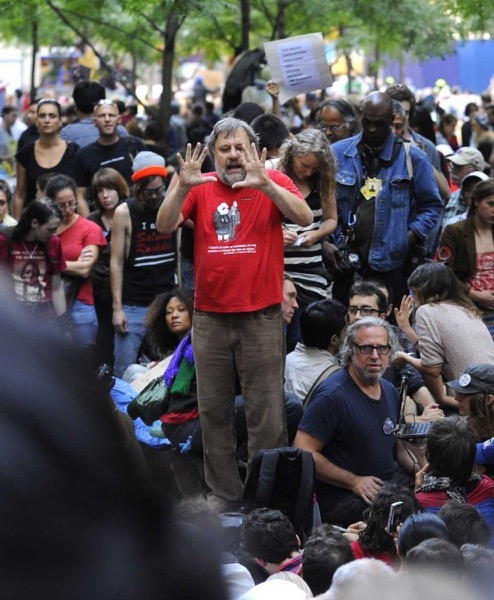
Zizek occupy wall street

2002 words, 10 min read

The Post-Marxist philosopher Slavoj Žižek is perhaps a surprising source of insights about the Holy Spirit, but I believe that his perspective is highly relevant for atheists and Christians alike. My first encounter with his thought on the subject was in a transcript of him addressing Occupy Wall Street protesters at Zuccotti Park in 2011:

“What is Christianity? It’s the Holy Spirit. What is the Holy Spirit? It’s an egalitarian community of believers who are linked by love for each other, and who only have their own freedom and responsibility to do it. In this sense, the Holy Spirit is here now. And down there on Wall Street, there are pagans who are worshipping blasphemous idols.”
Instead of being a throw-away comment of the moment, Žižek’s view of the Holy Spirit is the result of careful reflection from a number of viewpoints.

In a 2007 lecture - entitled “Meditation on Michelangelo’s Christ on the Cross” - he elaborated on how it is that the Holy Spirit is the source of the Christian community and pointed to the radicality of life that such a basis implies:
“The Holy Spirit is the love between believers; it is the spirit of the community of believers, according to the famous words of Christ: “For where two or three have gathered together in my name, I am there in their midst.” (Matthew 18:20) I think this passage should be taken literally. So what does this mean? Even today, the message is very radical. The temptation to be resisted is the temptation of meaning itself. […] I claim that Christ died on the cross precisely to reject [...] attempts at finding a higher purpose or meaning. Rather the message is: “Your standards matter to me. I throw myself into creation, and abandon my place up there.” The conclusions are radical. The ultimate meaning of Christianity for me is a very precise one. It is not: “We should trust God. The big guy’s with me, so nothing really bad can happen.” That is too easy. The message is not: “We trust God.” The message is rather: “God trusts us.” The gesture of Christ says, “I leave it over to you.” Usually we read religion as the way to guarantee meaning: We are concerned with the small details of everyday life and never know what will come of it all, or how things will turn out; we can only make wagers, and we do this maybe to ensure that God will arrange things in our favor. But the meaning of the death of Christ for me is the opposite: God made the wager on us. It is really a crazy wager, where God is saying: “I leave it to you. Holy Ghost, community of believers, you have to do it!””
In the same piece Žižek also demonstrates that his thoughts on the Holy Spirit are not merely an analysis from outwith or a thinking about an other, but that they are pertinent to his own context and community:
“[The] link between Christian community and the progressive movement is crucial. And here I’m not playing a cheap game of identifying radical political movements as a kind of religious community; what I’m referring to is the idea of a radical community of believers. The ideal is neither that of blind liberal individuals collaborating with each other, nor the old organic conservative community. It is a community along the lines of the original Christian community: A community of outcasts. We need this today, this idea of an egalitarian community of believers that is neither the traditional heretical community nor the liberal multiplicity. This is why I and many other leftist philosophers, such as Alain Badiou and others, are so interested in rereading, rehabilitating, and reappropriating the legacy of Paul. It is not just a matter of private religious convictions. I claim that if we lose this key moment—the moment of realizing the Holy Spirit as a community of believers—we will live in a very sad society, where the only choice will be between vulgar egoist liberalism or the fundamentalism that counterattacks it. This is why I—precisely as a radical leftist—think that Christianity is far too precious a thing to leave to conservative fundamentalists. We should fight for it. Our message should not be, “You can have it,” but “No, it’s ours. You are kidnapping it.””
Žižek’s thoughts on the Holy Spirit have deeper roots still, which go to the very heart of the Christian mystery of the Trinity and the incarnation. In a 2004 paper entitled “Death’s Merciless Love”, he reflects on how the transcendent-immanent, divine-human gap is resolved by Jesus’ death on the cross, which finds its fulfilment in and unity with the Holy Spirit:
“[I]n order for humanity to be restored to God, [Christ as the mediator between God and humanity] must sacrifice himself. In other words, as long as Christ is here, there can be no Holy Ghost, which IS the figure of the reunification of God and humanity. Christ as the mediator between God and humanity is, to put it in today’s deconstructionist terms, the condition of possibility AND the condition of impossibility between the two: as mediator, he is at the same time the obstacle which prevents the full mediation of the opposed poles. Or, to put it in the Hegelian terms of the Christian syllogism: there are two “premises” (Christ is God’s Son, fully divine, and Christ is man’s son, fully human), and to unite the opposed poles, to arrive at the “conclusion” (humanity is fully united with God in the Holy Spirit), the mediator must erase himself out of the picture. Christ’s death is not part of the eternal cycle of the divine incarnation and death, in which God repeatedly appears and then withdraws into himself, in his Beyond. As Hegel put it, what dies on the Cross is NOT the human incarnation of the transcendent God, but the God of Beyond Himself. Through Christ’s sacrifice, God Himself is no longer beyond, but passes into the Holy Spirit (of the religious community). In other words, if Christ were to be the mediator between two separated entities (God and humanity), his death would mean that there is no longer a mediation, that the two entities are apart again. So, obviously, God must be the mediator in a stronger sense: it’s not that, in the Holy Spirit, there is no longer the need for Christ, because the two poles are directly united; for this mediation to be possible, the nature of both poles must be radically changed, i.e. in one and the same movement, they both must undergo a transubstantiation. Christ is, on the one hand, the vanishing mediator/medium through whose death God-Father himself “passes into” the Holy Spirit, and, on the other hand, the vanishing mediator/medium through whose death human community itself “passes into” the new spiritual stage.

These two operations are not separated, they are the two aspects of one and the same movement: the very movement through which God loses the character of a transcendent Beyond and passes into the Holy Spirit (the spirit of the community of believers) EQUALS the movement through which the “fallen” human community is elevated into the Holy Spirit. In other words, it is not that, in the Holy Ghost, men and God communicate directly, without Christ’s mediation; it is rather that they directly coincide - God is NOTHING BUT the Holy Spirit of the community of believers. Christ has to die not in order to enable direct communication between God and humanity, but because there is no longer any transcendent God with whom to communicate.”
In a 2009 book entitled “The Monstrosity of Christ. Paradox or Dialectic?” and co-authored with the Anglican theologian John Milbank, Žižek challengingly draws the identification of the community of believers with the Holy Spirit and of the Holy Spirit with the crucified and risen Christ to its ultimate conclusion, which is a life at the end of history, a life of “ethical extravagance” and “permanent revolution”:
“There is, however, a third position between these two extremes, that of the Holy Spirit, of the apocalyptic community of believers, of the self-organization dialectical clarity versus the misty conceit of paradox of believers who drew from Christ’s nonreturn after his death the correct conclusion: they were awaiting the wrong thing, Christ already had returned as the Holy Spirit of their community. The very meaning of Christ’s death is that the work to be done is theirs, that Christ put his trust in them. Once we accept this, Eagleton’s reading of Jesus’ “ethical extravagance” also becomes problematic:
“What one might call Jesus’s ethical extravagance—giving over and above the measure, turning the other cheek, rejoicing in being persecuted, loving one’s enemies, refusing to judge, non-resistance to evil, laying oneself open to the violence of others—is . . . motivated by a sense that history is now at an end. Recklessness, improvidence and an over-the-top lifestyle are signs that God’s sovereignty is at hand.There is no time for political organization or instrumental rationality, and they are unnecessary in any case.”
But is this “extravagance” really constrained to the end-of-time atmosphere in which all we can do is wait and get ready for the Second Coming? Is it not that, in an apocalyptic time—the time of the end of time, as Agamben put it—we have both aspects, “ethical extravagance” as well as political organization? The specificity of the Holy Spirit, the apocalyptic emancipatory collective, is that it is precisely an organization which practices these “ethical extravagances,” i.e., which lives its life in an apocalyptic “state of emergency” in which all ordinary legal (and moral) commitments are suspended, practiced in the mode of “as if not.” The problem with the Church is that it betrayed original Christianity not by its organization, but by the type of this organization: the apocalyptic community of believers which lives in the emergency state of a “permanent revolution” is changed into an ideological apparatus legitimizing the normal run of things. In other words, with the Church, we are not active enough: the pressure of the Second Coming is eased, all we have to do is to lead our daily lives following the prescribed ethico-religious rules, and Salvation will come by itself.“
In summary, Žižek’s Holy Spirit - like all of Žižek’s Trinity - invites to a life of radical commitment in the present, to a life lived with and for others and therefore in God, a life steeped in freedom:
“So what I claim is that something absolutely unheard of happens with Christianity which is that Christ, the death of Christ, means something very radical. It means, in all other religions we trust God, we believe in God. The death of Christ [instead] means, God trusted us. It means, “I give you your freedom, it’s up to you.” The Holy Ghost for me is — and I take it literally when it says in the Bible “Whenever the two of you are there, I will be there, I am there.” — it means the gift of freedom. It means, God doesn’t want to play that “up there a guarantee,” it means God entrusts the fate of creation, his own fate, into us. It means what happens here is part of, as it were, the history of God. And […] à propos iconoclasm […]: the prohibition to make images of God in Judaism does not mean this gnostic way “oh it’s too mysterious, we cannot paint it.” It means the exact opposite! It means God is alive not in your stupid deep meditations of up there, but how you act and react with others. And that’s why you shouldn’t make images because it’s not an image to be made up there. And I think, if anything, even more this holds for Christianity. That’s for me what the Holy Ghost is. God is no longer the substantial master up there, God is — to put it in this way — the spirit of our community, the gift of freedom.”