Showing posts with label philosophy. Show all posts

Monday, 15 June 2015

Chiaretto: truth, freedom, unity

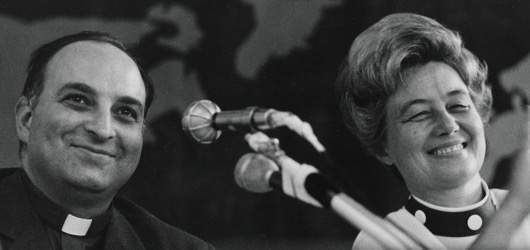
Chiara e Don Foresi

This morning, Don Pasquale Foresi, one of Chiara Lubich’s first companions and a co-founder of the Work of Mary, has completed his earthly journey. Don Foresi, known to his friends as Chiaretto, was a man who has given his life to God unreservedly and I am sure that there will be much written about him in the years to come. Instead of attempting to share an outline of his life here, I will focus on his thought, which shone with brilliance and where he displayed not only a love of the truth, but also great care for and familiarity with the world and the Church. Chiaretto was an extraordinary theologian and philosopher, but before all else, he was a follower of Jesus worthy of the apostles.

Chiaretto’s thoughts on prayer are something I shared here already, but since they are such a great example of his characteristic focus on the essential, let’s re-read them again:
Prayer does not consist in dedicating time during the day to meditation, or to reading some passages from Scripture or from the writings of the saints, or in thinking of God or our ourselves with the aim of some internal reform. This isn’t prayer in its essence.

Reciting the rosary or morning or evening prayers is just the same. One can do these things all day without ever having prayed even for a minute.

Prayer, to be truly such, requires above all a relationship with Jesus: to go with the spirit beyond our human condition, our worries, our prayers - no matter how nice and necessary they may be, and establishing this intimate, personal relationship with him.
In an early article in Nuova Umanità from 1979, Chiaretto embarks on an profound analysis of the first three chapters of Genesis, with the aim of examining the way woman is presented there and arriving at a conclusion of fundamental equality between her and man. Just to get a sense of his clarity of thought, take a look at the following excerpt:
“Verse 23 [of Genesis 2], which says that: “the man said: “This one, at last, is bone of my bones and flesh of my flesh; This one shall be called ‘woman,’ for out of man this one has been taken.”” is a hymn of joy of the man who has found his partner. He discovers the same flesh, the same bones. In Hebrew “flesh” had a far vaster meaning than in our languages, because there was no word for “body”. Von Rad sees in this verse the key to explaining the creation account of Eve; this is in fact about understanding one fact: the primordial attraction between the sexes - whence comes a love as strong as death?

It seems to me that the Yahwist writer certainly explains the origin of the sexes, but his story is far more extensive and elevated than that. It is not just about a differentiation internal to the first couple, but it is the story of how all of humanity is meant to be that is being presented to us.

The deep love, (made tangible by the account of the birth of woman from a rib) between the first man and the first woman, foreshadows the love between all beings that are to be born; hatred ought not to exist, because it is against one’s own flesh; that which later will be said spiritually, “then” was true also physically.”
Many years later, in a seminal paper from 2001 entitled “Doing philosophy,” Chiaretto presents a startling picture of what is at stake when true philosophy is sought:
“[P]hilosophy implies a risk: the risk of one’s own peace of mind. Doing philosophy, in the sense I intend, is to say: I prefer to take risks, not be calm; I want to know, I want clear things up, I want to go further beyond. And this is a terrifying step, because no one helps us, because the answers that all give us the feel prefabricated, something that is meaningless because we must look for the real answer within ourselves. Only in these moments do we know what the real problem is, we feel it, even if we can not express it yet, to clarify it, to say it. It is the choice of a non-peace in the face of the appearance of peace offered by the world around us. It is a choice that involves changing all relationships with others. Because of this I would say that one aspect of this tragic situation is that almost no one will understand us. The surprise implies a break with the world around us: that surprise which is the wonder of being in the world without being in the world. One is cut off from everyone else, one is alone, naked. You say one thing and the others will understand another; they say one thing and you maybe understand the contrary. Basically, you do not receive any solution from the others, and even though you know that you have to find the solution with others, one feels alone, not in the sense of not having company but in the sense of a radical, metaphysical impossibility of “feeling oneself with someone.” It is as if one lived in another world. It’s like entering a cave, with the risk of never coming out of it again. But none of this is of interest in those moments: “what will be will be,” I can not have peace until I accept to face myself, to face the problem of my existence and of my knowing myself. We realize that we are at sea, in an abyss, in a dark universe. We have only just started to walk and we can not turn back. There is nothing left but to press ahead. This is the drama of doing authentic philosophy.”
In a follow-up paper Chiaretto then argues for knowledge being intrinsically social, even though the journey towards it starts in that dark universe of the self that artists like Antony Gormley have explored with such beauty:
“Knowledge is always born in dialogue. All knowledge is a talking with others while addressing myself. Or, more precisely, it is a dialogue with myself which others are present intrinsically and profoundly. They will perhaps be present in a confused, imperfect way, but they are there. I never know solipsistically, even when when I know “by myself.”

What happens then when I give some of my knowledge to others? The words that I formulate to express and transmit that being that I perceived, are not only mine, but come simultaneously from me and from others: this means that when I offer what I have known, those who are listening to me are already inserted in the expressions that become formulated from before.

In telling others those words-knowledge of mine, they are completely, even if unknowingly, inserted in what I am saying, precisely because they have contributed to my knowing, they have given it to me and constructed it for me at least to some extent. Those insights are already the result of some communion with them.”
And finally, let me share with you Chiaretto’s synthesis of how Mary completes God making us in His own image, which is highly consonant also with how Pope Benedict XVI spoke about the Trinity in his “Introduction to Christianity”:
“God is the Father who gives himself wholly in the Son, who in turn wholly re-gives himself to Him. And their reciprocal love for each other - the relationship that unites them among themselves - is the Holy Spirit.

Being like God means therefore to live with Him in this same Trinitarian dynamic.

We, like all creatures, are called to being by God, just like the Son by the Father, and, precisely because we are his creatures, we tend to return to him in a relationship of love. Yet, this re-giving of oneself, even when total, of the creature to God, does not yet fully expresses its capacity to be like Him. Such a way of being does not in fact reach a “re-giving” of God to God, as it is in the Trinity. There, the Father is Father because he begets the Son. In other words, being Father is determined by the relation of sonship, that is, the Son being makes the Father be the Father.

To us too, then, created “in the likeness” of God, must be given the opportunity to give God to God, that is, to return to Him as creatures truly able to be his likes.

This possibility has taken on complete form on earth, at a given moment in history, in Mary.”
There would be so much more to talk about in terms of Chiaretto’s thought, but I believe that the above give a sense of his genius, even in the crude translations provided here.

Dearest Chiaretto, thank you!

Sunday, 8 December 2013

Possessed by truth: a journey

Color of truth

[Warning: long read.]

One of the points made by Pope Francis in his letter to Eugenio Scalfari at the beginning of September regarded the nature of truth, which he likened to a relationship and which he argued “embraces and possesses us” instead of us possessing it. In this post, I would like to revisit this passage and look at it, and related statements made by Cardinal Gianfranco Ravasi, through the lens of philosophy.

The question of truth is one of the central concerns of philosophy and theories about it impact a vast variety of other aspects of rational enquiry. Since it is such a central theme, my attempt to look at Francis’ and Ravasi’s words from the point of view of philosophy will necessarily be in the form of a very roughly-ground lens1 indeed and all that I can hope to convey are blurry silhouettes. To keep the argument at a high level (as much as I would love to delve into the depths, e.g., of Alfred Tarski’s approach), I will mostly stick to summaries provided in the Stanford Encyclopedia’s “truth” entry and round it out by headlines from the “truth” entry in the Wikipedia.

With the caveats out of the way, let’s first look at the concept of truth most akin to what is typically meant by this word in “ordinary language” (i.e., language as used without the machinery of technical definitions - effectively the language spoken by “the man on the Clapham omnibus” to borrow an expression from English law). Here, an expression, statement, declaration, description, account, etc. is true if it matches how things actually are. If I say “there is a cat on the mat” and there actually is a cat on the mat then what I have said is true. What does philosophy make of the concept though and how does it deal with the pandora’s box that spills out left, right and center, when a basic idea like truth is subjected to scrutiny and deconstruction (in “ordinary language” terms).

As the King said to Alice, very gravely, let’s begin at the beginning - or at least reasonably close to it - and look at how Aristotle (who had something to say about pretty much everything) thought of the truth. In his Metaphysics, he declares: “to say of what is that it is, and of what is not that it is not, is true” (Book 4, Part 7). This, in fact, is close to the everyday meaning of the word and a variant of what today would be called the correspondence theory of truth - a theory still adhered to by many philosophers today and a theory (or class of theories) that I too consider to be best representative of my own understanding.

Put in more contemporary terms, “[a] belief is true if and only if it corresponds to a fact.” There is immediately a host of questions that spring up: is belief the only possible “truth-bearer” or are there others, what is the nature of correspondence, and what is a fact and can there be other “truth-makers”? Put in more generic terms, the above definition becomes: “a truth-bearer is true if and only if it corresponds to a truth-maker.” Here truth-bearers include entities like beliefs, propositions, sentences or utterances, truth-makers can be entities like a world that exists objectively (i.e., independently of the ways we think about it or describe it), electrodes connected to a brain’s nerve endings in a jar, states of a self’s consciousness and correspondence can refer to a match on the truth-bearer’s structure to the truth maker’s structure or just to convention (i.e., the “situationist” argument). As is obvious, a sprawling tree of choices grows from under our feet even just by enumerating some of the options, never mind engaging with them.

As should be obvious from the “truth is truth-bearer corresponding to truth-maker” way of posing of the correspondence theory of truth, the schema lends itself to modification and also to analysis using mathematical, formal languages methods (as Tarski did - more about that in a future post ...). Still using my ultra-rough lens, let’s next look at G. E. Moore and Bertrand Russell’s identity theory of truth, where “corresponding” becomes “being identical to” - i.e. “a true proposition is identical to a fact [...] Propositions are what are believed, and give the contents of beliefs. They are [..] the primary bearers of truth. When a proposition is true, it is identical to a fact, and a belief in that proposition is correct.” This is essentially a flavor of the correspondence theory, cutting out the bearer-maker dichotomy.

The most substantial competing theory of truth though is the coherence theory, whose basic idea can be put as: “A belief is true if and only if it is part of a coherent system of beliefs.” Truth here is not constrained to individual truth-bearers (instead whole systems of beliefs are the primary truth-bearers) and is “not simply a test or criterion for truth. Far from being a matter of whether the world provides a suitable object to mirror a proposition, truth is a matter of how beliefs are related to each-other. [... It] insists that truth is not a content-to-world relation at all; rather, it is a content-to-content, or belief-to-belief, relation.”

Extending the two basic concepts of correspondence versus coherence are a host of other, more recent approaches. Here pragmatist theories (e.g., as propagated by C. S. Peirce) make truth be about its practical value, since “[t]rue beliefs are guaranteed not to conflict with subsequent experience.” Verificationism instead “holds that a claim is correct just insofar as it is in principle verifiable, i.e., there is a verification procedure we could in principle carry out which would yield the answer that the claim in question was verified. [.. T]ruth just is verifiability.” Deflationist theories (e.g., as put forward by Gotlob Frege) argue that there is no property of something being true - that the concept is redundant. “[A]ppearances of the expression ‘true’ in our sentences are redundant, having no effect on what we express.” Constructivist theories instead hold “that truth is constructed by social processes, is historically and culturally specific, and that it is in part shaped through the power struggles within a community.” This is, e.g., the truth theory that underlies gender theory. A related, democratized, alternative is consensus theory where “truth is whatever is agreed upon.”

In summary, and in Cardinal Ravasi’s words:
“There are essentially two opposing approaches to the concept. The first is a relativistic, subjective view which sees Truth as a sort of Medusa‐like figure, constantly changing appearance depending on the circumstances. [... This view argues] that Truth does not in itself have any ontological basis and, for this reason, should be left free to follow the course of continual change.

The second approach to Truth [...] holds that there is an objective – or rather, transcendent – Truth. [... Here] an emblematic image is provided in Plato’s Phaedrus, where the soul is likened to a chariot that flies across the plain of Truth. [...] Adorno, in interpreting one of the aphorisms of Truth in his Minima Moralia, maintained that “one does not have [the Truth], but is in it.” Hence, humanity, finding itself within the womb of Truth, uses the mind to take it in, to become familiar with it, to investigate and illuminate it. There is clearly an attempt to combine the two aspects: on the one hand, a Truth which precedes us; on the other, a Truth which the individual must choose to enter. We read in Robert Musilʹs The Man Without Qualities that: “The Truth is not a precious stone to be kept in a casket, but a sea in which to immerse oneself”. This approach emphasizes the primacy – or precedence – of Truth, which is to be understood not as dominion but rather as illumination: a Truth more complex than mere rational knowledge.”
In fact, it is the above concepts - from a talk by Ravasi in 2009 - that, to my mind, underpin Pope Francis’ response to Eugenio Scalfari a couple of months ago and already the positioning of truth in Francis and Benedict XVI’s Lumen Fidei: “truth leads to humility, since believers know that, rather than ourselves possessing truth, it is truth which embraces and possesses us. Far from making us inflexible, the security of faith sets us on a journey; it enables witness and dialogue with all.”

With all of that under our belts, let’s take a fresh look at Francis’ response to Scalfari:
“I would not speak about “absolute” truths, even for believers, in the sense that absolute is that which is disconnected and bereft of all relationship. Truth, according to the Christian faith, is the love of God for us in Jesus Christ. Therefore, truth is a relationship. As such each one of us receives the truth and expresses it from within, that is to say, according to one’s own circumstances, culture and situation in life, etc. This does not mean that truth is variable and subjective, quite the contrary. But it does signify that it comes to us always and only as a way and a life. Did not Jesus himself say: “I am the way, the truth, and the life?” In other words, truth, being completely one with love, demands humility and an openness to be sought, received and expressed. Therefore, we must have a correct understanding of the terms and, perhaps, in order to overcome being bogged down by conflicting absolute positions, we need to redefine the issues in depth. I believe this is absolutely necessary in order to initiate that peaceful and constructive dialogue.”
Armed with my rough, philosophical lens, the above looks to me very much like a correspondence theory: correspondence here is the relationship Francis speaks about, the truth-maker is God and his creation and the truth-bearer are my own, circumstance-, culture-, language-relative beliefs, thoughts and utterances. The truth-maker is absolute and objective, while the truth-bearer is ultimately its opposite: relative, in flux and existentially subjective. The image of a journey and of being embraced express the entities of this scheme in an intuitive way. On the one hand, the givenness and quiddity of the landscape, which envelops the traveller, and on the other hand, the subjective, observer-dependent experiences of it, had by the pilgrim (the "For now we see through a glass, darkly." of St. Paul (1 Corinthians 13:12)). What makes this paradigm profoundly Christian though is what Francis points to when he identifies truth with “the love of God for us in Jesus Christ.” The truth-maker is reaching out to the truth-bearer across the absolute-relative chasm, placing himself in relationship with His creatures, who are to Him like a dimensionless point is to the unbounded hyper-dimensional space.

Before you change channels, just bear with me while I try to put the above in other, less faith-dependent words. The concept of truth presented by Francis, as I understand it, is one that maintains the realism2 of a classical correspondence theory of truth, while acknowledging elements of contemporary truth theories that point to the impact of social, historical, conventional, linguistic and individually-subjective factors on the truth-bearers. Unlike truth theories that are marked by an absence of realism (e.g., coherence, pragmatist, verificationist and constructivist ones), here the imperfect and inherently subjective truth-bearers are still in relationship with their truth-makers. Up to this point, the theory does not make recourse to Christian beliefs and could just as easily be held by an atheist, in my opinion. Where it diverges is then in the belief that the truth-maker is not only an objective reality but also a personal agent who actively seeks to relate to the subject owning the truth-bearers. I didn’t say I’d put it more simply :)


1 Apologies to my überbestie MR - a fully-qualified and practicing professional philosopher - for bringing the name of philosophy into disrepute. I am sure she could have done a far superior job of the following.
2 And by “realism” I mean that the truth-makers are posited to exist independently of the truth-bearer’s circumstances - not the typical, ordinary-language meanings of the term.

Tuesday, 22 January 2013

The inescapable indulgence of philosophy

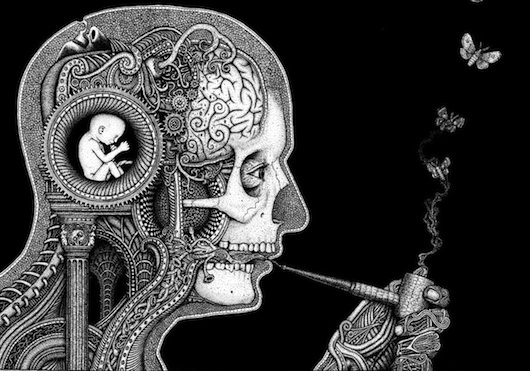
Homunculus drawing s

If you are not in the mood for reading a rant, please, kindly, move along to some calmer, more edifying post.

OK, so, for those of you who are reckless with you blood pressure, the topic of today’s rant is, yet again, the “Faith and Reason” section of the the “Our Faith on Sunday” leaflet that now accompanies my parish’s newsletter (for a previous run in with it see here). This time the topic is none other than philosophy, and it gets disposed of in less than 150 words.1 You’d think that those few words would have to be carefully chosen to say anything meaningful about a complex topic like this. Yet, instead, the opening words are the following:
“Every person will at some stage in life indulge that inescapable curiosity which seeks answers to philosophical questions; even small children exhibit impressive levels of philosophical inquiry when, during the so called ‘Why Stage’, they demonstrate an insatiable desire to know the causes of things.”
The unidentified author of the above wisdom then drops gems like: “[h]ow articulate and explicit each person’s philosophical investigation is will depend on circumstances,” “there is in human nature a questioning quality, an irresistible urge to find out” and “although no single philosophical system can claim to give us a complete account of reality, some do reflect it more fully than others.”

Two words: WOW! Where do you even start in the face of such platitudes and inanity? First, let’s just spell out what the above actually implies about philosophy:
  1. The opening line makes philosophy sound like sneezing, a temporary infatuation with Brad Pitt or the onset of puberty. It makes philosophy seem like something that may one day overcome you, out of the blue. You’ll have no control over it and you’ll just have to indulge it. But, don’t worry - it will pass …

  2. Philosophy may also have the hallmarks of a disease - how serious its symptoms will be in your case (and at some point it will wash over you for sure) depends “on circumstances.” It would have been useful to get at least at hint of what it is about “circumstances” that may make a philosophy attack more or less severe. Is it open spaces, high altitudes, allergens or the presence of nanosphere complexes that one should watch for?

  3. The paragon of philosophical activity is a small child asking “why?”. Having actually been at the receiving end of barrages of “why”s by small children (and having greatly enjoyed the game), I am therefore inferring that the purpose of philosophy is entertainment, attention-seeking and maybe in 1/10 of its instances an actual desire for an answer. [Well, this one may not be that far off :)]

  4. You may find this hard to believe, but some philosophical systems reflect reality more fully than others … Mind. Blown. I would love to see the unidentified author of this gem of a treatise on philosophy sketch out how one might go about determining the extent to which a given philosophical system reflects reality. Maybe we could have a star rating in next week’s newsletter. (Dialectical materialism: x stars, Neoplatonism: y stars, Deconstructivism: z stars … You didn’t think I’d actually assign specific values, did you?)
“It is easy to be critical,” I hear you think. So, let me show you how I would use a ~100 word limit to talk about philosophy (and I’d do so by letting another, far better qualified mind, speak):
“Men and women have at their disposal an array of resources for generating greater knowledge of truth so that their lives may be ever more human. Among these is philosophy [meaning “love of wisdom”], which is directly concerned with asking the question of life’s meaning and sketching an answer to it. Philosophy emerges, then, as one of noblest of human tasks [… and] shows in different modes and forms that the desire for truth is part of human nature itself. […] Through philosophy’s work, the ability to speculate […] produces a rigorous mode of thought; and then in turn, through the logical coherence of the affirmations made and the organic unity of their content, it produces a systematic body of knowledge.” (John Paul II, Fides et Ratio)


1 I owe it at least to my überbestie MR (née MM) to rush to the defense of philosophy. Not that it is being attacked particularly efficaciously here, but an attack is an attack and this one is bringing the game into disrepute … its a matter of principle!

Tuesday, 4 December 2012

In search of joy

Joy

As I haven’t managed to write a post here for over a week, I would just like to take the opportunity now to tie together a couple of the strands of the last seven days, which happen to have a shared theme of joy.

First, there is a talk by Pope Benedict XVI that I have been wanting to read for a while and that I finally got to last night. It is the first sermon he gave after the start of the Year of Faith, where he sets out to - what else - talk about the nature of faith. Amongst other things (and I encourage you to read the original in full), he says that “[f]aith is a gift of God, but it is also a deeply human and free act” and he asks himself how we can get “that openness of heart and mind […] to believe in the God.” The answer Benedict puts forward comes from Dei Verbum (§5): “To make this act of faith, the grace of God and the interior help of the Holy Spirit must precede and assist, moving the heart and turning it to God, opening the eyes of the mind and giving “joy and ease to everyone in assenting to the truth and believing it” (Second Council of Orange, Canon 7, 529 AD).” And this makes him conclude: “To believe is to trust freely and joyfully in God’s providential plan” and saying “yes” to God “transforms life, opens the way towards fullness of meaning, thus making it new, full of joy and of reliable hope.”

Second, this joy and freedom of choice (also supported by the ultimate emphasis placed on the freedom of conscience in the Catechism (§1790)) then lead to lives like those of the saints, whom Benedict considers to be “the greatest apologetic for our faith,” alongside art. The accessibility and attractiveness of the joy that another person has, was then one of the topics that I spoke about with my bestie JMGR - a (in my opinion accurately) self-proclaimed “born-again agnostic” :). While our beliefs and views cannot be transferred to another and can remain the subject of doubt and suspicion, the joy and goodness of another’s life is accessible to us regardless of what we think about their beliefs. We can recognize the goodness of the fruit and as a result be more receptive to listening to the tree. A related theme that came up during our chat was also the role of uncertainty in the context of building personal relationships. Acknowledging the fundamental limitations of knowledge (which make it impossible to go beyond one’s self epistemologically) can lead not to indifference or nihilism (which is exhausting) but instead to openness and a greater readiness to hear out those who hold other beliefs.

Third, preceding these explicit instances of thinking about joy as the primary focus, was my reflecting on the activities of aggressive atheists like Richard Dawkins and realizing that I should be grateful for them! On this blog alone, I have confronted their claims repeatedly (about goodness, rationality, science, cosmology) and have always come away from the process enriched both because I read up on the relevant science or philosophy and because I have discovered that the views held by the Church (through the Catechism, the teaching of the Popes or the insights of the Saints) are eminently rational, warmheartedly open and very much my own. There is also no denying the fact that the Church’s teaching has become what it is today also in response to attacks from militant atheists, which have meant that it had to think more carefully about how faith and reason relate and to clean itself from some aberrations that have crept in over the centuries.

Fourth, a very good friend of mine – MK – has been a constant source of joy to me over the last months, during which he has been battling with a serious, life-threatening disease. Throughout this time he has been sharing his experiences on Facebook and on a blog, where he chronicles his battling with the disease, while firmly keeping his sight set on God and on loving his neighbors. His blog is such a source of light for me that I could pick a paragraph at random and share it with you here. In fact, I am just going to share the beginning of what he wrote today:
“I am a child of God not by merit but by a gift of love from Him. Not only that, everybody else is a child of God and if God is our father, we are brothers and sisters, equal! Sounds obvious, but from my, our behaviour, we don’t treat each other as equal. How many times do I put me before loving God in my neighbour. I have all the experience in this and that, I know best, because I have done it before, I have a talent from God! More and more I discover that all these things are given into my hand to make his love visible! When I and my talents, inspirations and gifts from God get in the way of taking time to love my neighbour, it is always me. Where there is me there God can’t be! Here is the challenge: To love the way Jesus loved when he was on the cross, giving everything, becoming nothing out of love!”
True joy is rich, rewarding and all-encompassing. It is not a matter of only the good, easy times, but an insight and gift that transforms challenge, difficulty and suffering. My bestie Margaret once wrote the following to another bestie of ours - DF - and me: “Hope all is very very well (I mean, of course all manner of things are always well because we are loved immensely, so maybe I should wish that you are in the state where you are able to see that it is).” That too is joy and I couldn’t put it any better myself.

Thursday, 4 October 2012

From individual to person

Community1

I am feeling quite “meta” today and have no less than four reasons for it: first, what I am about to discuss is fundamentally meta, second, the act of writing about it to you is an instance of it, third, it ties several of the strands that I started in previous posts together, and, fourth, it has come to me in a way that illustrates the topic itself (thanks to my bestie, Margaret, of ‘the God of Explanations’ fame). If that is not enough to pique your interest, let me add that it is centered around a talk given by one of my favorite contemporary thinkers - Dr. Rowan Williams, the Archbishop of Canterbury.

The subject of the talk is an exploration of what it means to be human and revolves around the distinction between an individual and a person. In customary magisterial fashion, Archbishop Williams ties together the thinking of St. Augustine, Orthodox and Catholic theologians (Vladimir Lossky and Robert Spaemann), a Russian and a French philosopher (Mikhail Bakhtin and René Descartes), a French thinker (Alexis de Tocqueville), a psychotherapist (Patricia Gosling) and an LSE sociologist (Richard Sennett). The argument begins by claiming that the relevant polarity is not between individualism and communitarianism but between the concepts of an individual and a person.

Here an individual is simply an example of a certain thing: e.g., Bob is an example of a human being, just like Fido is an example of a dog. Seen from this “atomic” perspective (where, incidentally, “individuum” is merely the latinized version of the Greek “atomos”), the individual is the center of their own world – its solid core. Even when they engage in relationships with others, they always have “the liberty of hurrying back home,” and the best relationship they can have with the world, that is separate from them and beyond them, is control. The consequences of such a view of what it is to be human are alienation, non-cooperation and unease with limits. This view is summed up clearly by de Tocqueville saying that “[e]ach person, withdrawn into himself, behaves as though he is a stranger in the destiny of all the others.” It is also the psychological and anthropological parallel of the epistemic approach pioneered by Descartes (and driven to its limit in the “brain-in-a-vat” scenario), that I also adapted in an earlier post and that, in art, is mirrored by Antony Gormley’s approach to sculpture.

The other concept of a human being is that of a person, where there is “something about us as a whole that is not defined just by listing the facts that happen to be true about us” and where a person is a “subject [that is] irreducible to its nature” (Lossky). Williams argues though that while “we know what we mean by personal/impersonal and persons in relation, […] we struggle to pin down what we mean that we cannot be reduced just to our nature.” He then goes on to postulating that “what makes me a person and distinct from another person is not a bundle of facts, but relations to others. I stand in the middle of a network of relations.” This leads to the definition of a person as the “point at which relationships intersect.”

Williams then moves on to the question of how one is to determine whether another is a human person and, following from the previous analysis, concludes that this cannot be done on the basis of a checklist for whether a given set of pre-requisites are present. Instead, we need to “form a relation, converse, to determine whether another is a person” and that language helps us to decide. He is quick here to move from a narrow concept of language as verbal only to a broad one that includes gestures and the “flicker of an eyelid.” This means that “[p]ersonal dignity or worth is ascribed to human individuals because, in a relationship, each of us has a presence or meaning in someone else’s existence. We live in another’s life. Living in the life of another is an implication of the profound mysteriousness about personal reality. Otherwise you end up with the model where somebody decides who is going to count as human.” Such a test of human personhood based on relateability very much reminded me of Turing’s test of machine intelligence, where the basis again is not a predetermined set of criteria, but the ability for a machine to converse with (relate to) a human person and for that person to recognize the machine as a person. Williams’ point about “each of us [having] a presence or meaning in someone else’s existence” also brought back echoes of Martini’s “the other is within us.”

How does the individual (which is by far the position with the strongest epistemic justification) see themselves as a person though? Here Williams quotes the following passage from Spaemann:
“Each organism naturally develops a system that interacts with its environment. Each creature stands at the center of its own world. The world only discloses itself as that which can do something for us; something becomes meaningful in light of the interest we take in it. To see the other as other, to see myself as his “thou” over against him, to see myself as constituting an environment for other centers of being, thus stepping out of the center of my world, is an eccentric position. […] As human beings in relationship, we sense that our environment is created by a relation with other persons; we create an environment for them and in that exchange, that mutuality, we discover what person means.”
How do you “step out” and assume an “eccentric position” tough? Here, Williams admits that such “stepping beyond one’s own individuality requires acts of faith. Living as a person is a matter of faith.” And I completely agree with him - strictly from a position of introspective enquiry, from Gormley’s “darkness of the body,” there is no fact-based way out. There is a need for a Kierkegaardianleap of faith,” but I would like to argue that it does not require a belief in God and in fact is akin to Eco’s communist acquaintance’s belief in the “continuity of life” discussed in an earlier post.

Finally, let’s also look at what Williams says about the aspect of personhood that is revealed as a consequence of belief in God:1
“Before personal relations, we are in relation with God. I am in relation to a non-worldly, non-historical attention which is God. My neighbor is always somebody who is in a relation with God, before they are in a relation with me. There is a very serious limit for me to make of my neighbor what I choose. They don’t belong to me and their relation to me is not what is true of them or even the most most important thing that is true of them. Human dignity - the unconditional requirement that we attend with reverence to one another - rests firmly on that conviction that the other is already related to something that isn’t me.”
In summary, a very clear picture emerges here, where I can think of myself as an individual - a world unto myself - or as the intersection of relations with others that allows me to go beyond myself and recognize in others that they are part of my world and I part of theirs. As a Christian this eccentricity also reveals to me that the relations I have with others build on the relations He has with them already and allow me to relate to Him not only in the intimacy of my self but also through my neighbors.


1 As an argument, this is essentially a variant of Bishop Berkeley’s response to the following challenge to his philosophy, where being is predicated on perceiving:

There was a young man who said God,
must find it exceedingly odd
when he finds that the tree
continues to be
when noone’s about in the Quad.

To which Berkeley responded with another limerick:

Dear Sir, your astonishment’s odd
I’m always about in the Quad
And that’s why the tree
continues to be
Since observed by, yours faithfully, God

:)))

Tuesday, 25 September 2012

Belief in theory moves mountains

Theory moves mountains s

Long before a piece of evidence is found for a theory, its postulators need to have faith in it, or at least entertain the possibility of its truth before they have the data to back it up. The first test(s) of a theory may well seem to disprove it, which in the absence of faith ought to be the end of it. However, even a simple, but sufficiently potent, idea carries the potential for “incomprehensible complexity” (see E. O. Wilson’s WWW Conference talk) and therefore also for an incomprehensible complexity in confronting it with evidence. Testing needs to be commensurately advanced relative to the theory for it to lead to either support for or conflict with it.

Many a beautiful theory may well lie dead as a result of an ugly fact (see Thomas Huxley), while the fact is simply not in correspondence with it, as a result of the grotesquely naïve view that a theory-fact mismatch always points the finger of blame at theory. Evidence is as much prone to error as the postulation of theories and all that one can hope to achieve in science is evidence-theory consistency. The absence of such understanding and a lack of faith in a fledgling theory are as damaging to science as is a disregard for data.

Science needs faith as much as religion does, for it to be capable of feats like landing a vehicle on Mars, propelling a human into space, setting off on a ship due west from Portugal in the anticipation of reaching land or building the dome of the cathedral in Florence. In all these cases, theory preceded evidential support and there was significant risk associated with failure, ranging from a huge waste of resources and careers being on the line to death. This is not to say that science and religion are the same, but simply to underline the fact that faith is needed in the practice of advancing science as much as it is for internalizing the doctrines of a religion (more on the role of evidence in the two cases another time :). While scientists (including myself) may rightly point to the fact that a theory ultimately needs to be matched up with reliable evidence for it to persist, I would like to argue that this in no way detracts from my claim that faith is fundamentally necessary for the practice of scientific enquiry and resulting advances, since evidence may often be decades away from theory (see Higgs’ theory postulated in 1964 and supported by evidence in 2012 – 48 years later!).

You may wonder, “Why are you bringing this topic up today?” The answer is simple – my besties PM and JMGR and I have been working on a theory that we postulated almost two years ago (and in a general form with PM five years ago) and it was in these last days that we have found the strongest evidence for it. Along the way we have been faced with a string of failures that could have meant the end of it and that would have resulted in us never discovering the groundbreaking results that now reward us for our persistence. I thank them both for their support!

[UPDATE (27/09/2012)]: I have just received a great message from my bestie, RR, who – unlike me: a peripheral tinkerer – is a real scientist (at Caltech, no less!) and who told me that I was “perfectly on mark with paragraph 3" :) Thanks for the nihil obstat, RR!

Sunday, 2 September 2012

Orthodoxy and/or orthopraxy

640px Ariel between Wisdom and Gaiety

What is the relationship between correct belief (orthodoxy) and correct action (orthopraxy) and how much does one matter versus the other? Is it more important what you think or what you do? While this is not a new question, I believe it is still a key one today.

Starting with Jesus, we can see him emphasizing both orthopraxy (also as a means of inferring orthodoxy when heterodoxy may be suspected):
“By their fruits you will know them. Do people pick grapes from thornbushes, or figs from thistles?” (Matthew 7:16) and

“Not everyone who says to me, ‘Lord, Lord,’ will enter the kingdom of heaven, but only the one who does the will of my Father in heaven.” (Matthew 7:21)
and validating orthodoxy in spite of it’s proponents’ heteropraxy:
“The scribes and the Pharisees have taken their seat on the chair of Moses. Therefore, do and observe all things whatsoever they tell you, but do not follow their example. For they preach but they do not practice. They tie up heavy burdens [hard to carry] and lay them on people’s shoulders, but they will not lift a finger to move them. All their works are performed to be seen.” (Matthew 23:2-5)
Looking at Jesus’s teaching, there is a clear preference for orthopraxy (whose absence is an obstacle and which will also be the basis for the questions asked at the last judgement about feeding the hungry, quenching their thirst, welcoming strangers, clothing the naked, caring for the sick, visiting prisoners, … (Matthew 25:31-46)) but orthodoxy is valued in its own right as a (non-exclusive) means for engendering orthopraxy (and, by Christians, as a gift from God). In a way it can be seen as being assumed to be present at least implicitly, partially, unconsciously in those behaving orthopractically.

Let me just pick out two examples of where this principle of orthopraxy being taken to assume (implicit) orthodoxy has been employed by Jesus’ followers - a very recent one and a rather ancient one:
  1. Saint Pope Gregory the Great (6-7 century AD) was so taken by the justice that the emperor Trajan (1-2 century AD) has shown towards a widow, who violently lost her only son, and by his virtue that he prayed for the salvation of his soul and it’s promotion from purgatory to heaven. In other words, Gregory was motivated by Trajan’s orthopraxy to petition for his receiving the rewards he thought were only due to the orthodox.

  2. Archbishop Müller, when questioned about his friendship with Gustavo Gutiérrez, the father of Liberation Theology, responded: “The theology of Gustavo Gutiérrez, independently of how you look at it, is orthodox because it is orthopractic. It teaches us the correct way of acting in a Christian fashion since it comes from true faith.” This is not to say that all of Liberation Theology is exonerated by virtue of the virtue of its followers (the Vatican’s criticisms of Marxist influences in some of its strands are upheld by Müller), but that the virtue of its followers is a fruit of their orthodoxy.
All of this links rather nicely with Martini’s idea of (non)believers and is another argument for appreciating the orthopraxy of all while also valuing beliefs that can lead to it. I also believe it is a key to reading some Protestant–Catholic differences, to relating the lives of saints and Church doctrine and to appreciating great works of art created by artists who have committed heinous crimes (a.k.a., my roadmap for a couple of future posts :).

Saturday, 1 September 2012

Martini & Eco: ethics for (non)believers

Martini eco

The passing of one of the princes of the Church is always a call for me to find out a bit about them, if I didn't know of them already, and Cardinal Martini, whose dies natalis was yesterday, is no exception. I'll leave it to you to find out about him for yourself (and there is certainly interesting material widely available across the internet) and will instead spend a couple of paragraphs talking about a topic very close to my own heart: the relationship between believers and nonbelievers, which is also the subject of a great book (or rather pamphlet as it is only 60-odd pages in length) containing the correspondence of Carlo Maria Martini and one of my favorite writers and an agnostic, Umberto Eco. The book is entitled “Belief Or Nonbelief ” and I highly recommend it to you in full.

The two points I would like to pick out here (and I may return to others covered there in the future) are what constitutes (non)believers and whether one can think of a common basis for ethics that can be shared by all.

In the introduction, by Harvey Cox, Martini is quoted as saying the following about (non)believers:
When I think about “believers” and “nonbelievers,” I don't have two different groups of people in mind. In all of us there is something of the believer and something of the nonbeliever, and this is true of this bishop as well.
As soon as I read this, I knew that I was going to enjoy the whole book - and I was not disappointed. After tackling topics like hope, human life and the role of men and women, the pair – who deliver a masterclass is dialogue (neither trying to trip up or ridicule the other, striving to deepen their understanding of each other’s positions) - turn to the question of whether there is common ground in terms of the ethical basis of believers and nonbelievers.

The question is posed by Martini, who asks: “what guides a secular person[, who does not recognize a personal God or appeal to an Absolute, to] profess moral principles, principles so firmly held that the person would give his life for them?” Martini acknowledges that all have ethical foundations and that even believers would often not seek recourse to God when making decisions under ordinary circumstances. What interests Martini is what happens in extremis - when one’s life is at stake – and he also pays homage to nonbelievers who have sacrificed their lives for their moral convictions or performed acts of great altruism. He is particularly keen to drill down to the foundations, which kick into action when things are pushed to their limits and wants to sweep away the consequences of “custom, convention, usage, functional or pragmatic behavior, even social necessity” and get to life and death choices which these can’t underpin.

To answer his question on behalf of believers, Martini points to inter-religious efforts that have looked into it and that point to it being “transcendental Mystery” that forms the basis for moral action. For Christians this is the Trinity, which provides us with “God the Father, Creator of All, and our brother Jesus Christ,” who give us an impulse to closeness and solidarity with others and who express that “the other is within us.”1 Quoting Hans Küng, Martini also points out that this basis makes ethical values “binding unconditionally (and not simply when it’s convenient) and hence universally (to all classes, ranks, and races).”

Eco’s2 response kicks off with an admission of his, now lost, Catholic roots and the realization that their past presence cannot be factored out. Given such caveats, he states that there can be a sense of the scared and of “communion with something greater even in the absence of faith in a personal and provident deity,” but he rightly comes back on track by reiterating the focus on that which is “binding, compelling, and unrenounceable” in secular ethics.

Eco cleverly and appropriately widens the scope of the question to universals and not just their application to ethics and proceeds with a magisterial introduction to “universal semantics3 – i.e., that “notions common to all cultures exist” (citing examples of referring to our position in space - up, down, left, right, …). After postulating the universality of perception, memory, desire, fear, pleasure, pain, … Eco steps back and draws our attention to there being not only universals applicable to the “solitary Adam,” but that sex, dialogue, parental love or the loss of a loved one provide social ones too. Poignantly Eco exposes the underlying implications of the semantic basis so far - that of focusing on ‘us,’ and on restricting the “other” or Martini’s “the other is within us” to those from our own tribal group, ethnicity or circle. Those outwith are inhuman and may therefore be treated barbarically even while members of one’s own group are afforded respect. Eco places the growth of who is considered a member of one’s circle at a millennial scale and cites even Jesus’s coming as having been conditioned by when humanity was ready for his teaching of the Golden Rule.

To get to the basis of what can drive a nonbeliever to give their life for a moral principle, Eco cites the example of a “communist” whom he asked how he, an atheist, can make sense of “something as otherwise meaningless as his own death.” “By asking before I die for a public funeral, so that, though I am no longer, I have left an example to others.” Eco argues that it is this “continuity of life,” a sense of duty to those who come after us, “because in some way what one believes or what one finds beautiful can be believed or seen as beautiful by those who come after.”

In essence my take on this exchange is that Martini threw a bit of a curved ball, knowing that Eco’s answer can but elaborate the consequences of his own beliefs about the roots of morality since he also believes that God is present in all - whether they believe in him or not. Eco did hold his own though by turning the situation around and highlighting the value of the Christian story, whether it is true or not. What they have done together is present a case for the Golden Rule both from divine revelation and from semantic analysis. I only see winners in this exchange: Martini’s “the other is within us” and Eco’s “continuity of life” form a pair of insights that, I believe, enrich all (non)believers :).


1 See my take on the epistemological parallel of this concept here.
2Please, note that, unlike Cardinal Martini for Catholics, Eco is not an official representative of nonbelievers and his answer therefore cannot be taken even as being intended as an answer on behalf of all nonbelievers. I, therefore, also don’t take it as such and don’t presume that, if you are a nonbeliever, it represents you. If you do happen to be a nonbeliever reading this and either agree or disagree with Eco’s take, I’d very much appreciate hearing from you in the comments. Thanks! :)
3 Semantics being the “study of meaning.”

Somewhat off-topic is another gem from the book - a reference of Eco’s to Kant’s take on atheism: how can one not believe in God, maintain that it is impossible to prove his existence, yet also firmly believe in the nonexistence of God, claiming that it can be proved :)

I would, finally, also like to dedicate this post to my bestie, SH - the most sincere agnostic I have ever met and a man who to this day teaches me humility by consistently beating me at scrabble, typically by a factor of two ...

Monday, 27 August 2012

I say polygon, you say polyhedron


When you look at the above image, what do you see? Two triangles and five quadrangles, a cube or something else? Now, let’s turn to the following thought experiment:
You are strapped into a chair, your head held firmly in place, and you see a bright, diffuse screen in front of you, showing a series of black lines. You notice that the screen can go from an only-just visible black point at its periphery, via lines cutting across it or forming triangles with its edges, to closed squares or even constellations of polygons moving and morphing across it. You also notice that there are several knobs and levers at your disposal and that you can influence the shapes seen on the screen. Your task is to work out how the patterns you see are formed.

All you have access to in this case is a sequence of experiences of a two-dimensional, bounded world, yet through painstaking experiments you come to the realization that what you are seeing is consistent with there being a wireframe cube behind the screen. All the patters, the changes from one pattern to another and the lengths of edges could be the result of a wireframe cube casting a shadow. Once you arrive at your conclusion you are released from your restraints and are free to exit the room. As you do so, another person exits the room next to you. A quick chat reveals you had the same experience, but it turns out that they are convinced that it was just a computer screen rather that the silhouette of a mesh cube. You enter each other's rooms and realize that they look identical! You believe their room shows a 3D cube’s shadow; they believe your room contains a 2D computer-driven display. You both look for a way to access what is behind the respective screens and after a while you find the rooms backing onto your two ones. Your screen and theirs were indeed driven differently: one was a display driven by a computer and the other a piece of translucent plexiglass having a backlit cube cast shadows on it. Which was which remains a secret guarded by the two of you.

Now, my question to you: who was the more rational participant in this experiment? The person postulating a 3D entity on the basis of strictly 2D evidence or the person whose theories remained firmly 2D, in line with the nature of their evidence?

I would like to argue that they were both equally rational and that the distinction between them was not along rational-irrational lines and to underline the fact that they were both deriving their world views from the same evidence.

What was the point of this whole exercise though? It was to propose that empirical evidence alone is not sufficient to constrain explanation to a solely empirical domain (even just the use of mathematics in science, with its universal quantifier is beyond the empirical) and that the exact same experiences can be held up as a basis for alternative theories.

The last exegetical point I’d like to make though is that the two protagonists of the thought experiment can learn a lot from each other. The person hypothesizing the 3D cube can lend the other means for simplification while the strictly 2D person can share a more refined understanding of 2D relationships, which also enrich the cube’s understanding.

Why is it that I am concerned by the evidence-theory relationship and try to dig into its nature? It is because this is a key stumbling block in the rapprochement between atheist scientists and the rational religious. The former don't get how the latter can transcend evidence while the latter are threatened by the former’s insights into empirical evidence. The many-to-many nature of the evidence-theory relationship also underlies inter-religious dialogue. Since the transcendent is infinite, hyper-dimensional and vastly exceeding the fragmentary insights we can have of it, also in terms of aspects we don't even know about!, it is understandable that different interpretations of its actions have been formed in different cultures and by different people. It would be short-sighted to stop at an incompatibility between the monotheism of some religions, the personal Trinitarian insight of Christianity, the polytheism of Hinduism and the apparent atheism of Buddhism (in the strict sense of atheism as opposed to its current use as anti-theism) and arrive at the erroneous conclusion that these religions talk about different things rather than differently about aspects of the same (please, don’t mis-read this as me saying that everything that all religions claim is true, that all religions are equally true or that religions can be freely intertwined and recombined. End of caveat :).

If there is a God, who is infinite, transcendent and vastly more complex than us, wouldn't his actions as experienced in our limited realm lead precisely to the variety of religions as well as agnosticism and atheism that we see today?


Just a quick hat-tip to Flatland, to the Chinese Room thought experiment and to the story of the blind men and an elephant (and surely to many others :).

Thursday, 16 August 2012

A self thinking thoughts that are (or, an invitation to epistemic honesty)

Gormley

Language.

Thought.

Being.

Self.

A much more honest kick-off to a quest for reliable knowledge than René’s “cogito ergo sum.” But where to go next? With a self thinking thoughts that are, how do we get to knowledge of a world beyond? I believe I can't, or rather, that I can't know. All I have access to is my self. How about sensory experiences though? Well, those are still only parts of me - the stream of images, sounds, smells, textures, temperatures, pressures, movements are nothing but events internal to me. Are they caused by a world beyond me? Just from what I have to go on, there is no way of telling.

You say though that you see the same moon, trees and world as I describe, so it must be other than both you and I. But, no ... I only have my own experiences of you at my disposal and you may as easily be entirely part of me as an independent inhabitant of an external universe.

And, invoking Occam’s blade won't get you anywhere either: surely a universe where only I, with my complex imagination, exist is simpler (but, I am not saying more believable) than one where myriads of entities inhabit a material world.

Admittedly, many have set out down this route (Descartes and Russell being only two of my many fellow travelers - needless to say, known to me only as parts of my self) but none, to my knowledge, have stayed true to their initial rigor.

The insurmountable epistemic chasm between the self and anything potentially beyond it is precisely that: an chasm insurmountable by knowledge. All I will ever have access to is me: whether it prima facie looks like you or an external world or not. With epistemic honesty no secunda facie is accessible and, I have to say that both René and Bertie have let themselves be blindsided by ‘reasonable’ arguments that made them fudge the chasm and build magnificent edifices of knowledge on air.

Maybe you'll want to call my bluff (à la Camus’ Myth of Sisyphus, where he challenges all who truly believe life to be absurd to commit suicide) and either say: “Come on, old girl, you've had your fun. Surely you can't believe this. Look around you: how could all this just be in your head?!” to which the answer should be obvious from the above.

Or, you could try a different, more subtle, line of attack: “If you really don’t think there is anything beyond yourself, why bother doing anything. Doesn't it make progress, compassion, love and the suffering of others meaningless?” To which I’d admonish you with a quick: “Check yourself before you wreck yourself.” Why should the events that I only have access to via my own experiences be any less seriously confronted in the absence of knowledge of their origin? Experiencing what appears as someone else’s suffering is an experiencing of suffering and cries out for remedy and consolation. If anything, it makes all suffering my suffering and therefore gives its resolution heightened urgency and immediacy. All this is to address only a misinterpretation of what I have said though. Stating that nothing beyond the self can be known (since I only ever have access to myself) does not mean that beliefs cannot (or even ought not) be held about the existence of others or a shared world (or that reason cannot be applied to structuring, explaining and predicting experiences consistent with an external world). All it means is that these beliefs, if held, are not derived from experience but additional (though not contrary) to it.

I don’t see any reason to break with epistemic honesty and deny the epistemic inescapability of the self so that questions beyond the self can be addressed. All it takes is being honest about involving beliefs or at least assumptions.

UPDATE (24/09/2012): Having just listened to Antony Gormley’s talk at the latest TED conference, I am delighted to see that his approach to sculpture very much parallels the above epistemological argument. Unlike ancient Greek sculptors, who tried to get at a sculpture trapped in a block of marble, so to speak from the outside, Gormley’s approach is the opposite. He starts from the “darkness of the body,” which he invites us to explore as follows:
“Do you mind if we do something completely different? Can we all just close our eyes for a minute? Now, this isn't going to be freaky. It isn't some cultic thing. (Laughter) It's just, it's just, I just would like us all to go there. So I'm going to do it too. We'll all be there together.

So close your eyes for a minute. Here we are, in a space, the subjective, collective space of the darkness of the body. I think of this as the place of imagination, of potential, but what are its qualities? It is objectless. There are no things in it. It is dimensionless. It is limitless. It is endless.

Okay, open your eyes.

That's the space that I think sculpture – which is a bit of a paradox, sculpture that is about making material propositions – but I think that's the space that sculpture can connect us with.”
Gormley’s “darkness of the body” is where epistemic honesty needs to start and where it remains even when we open our eyes.

Wednesday, 8 August 2012

Gang up on the green!

Temple gardens

The last week has seen a discouraging pair of shots being fired between the religious and atheists camps in the form of an article in the Catholic Herald by Fr. Alexander Lucie-Smith and a response to it by the biologist Prof. Jerry A. Coyne.1

I will leave it to you to read the two articles for yourself and won’t attempt to challenge the many individual shots fired by the two sides, as tempting as that is. The problem of evil, Nietzsche’s philosophy, nihilism, alternative theories of meaning, the nature of empirical observation, inference, theoretical parsimony and (lack of) evidence for God are all used as bullets, but without any attention paid to attempting a meeting of minds and certainly without any effort made to apply the principle of charity by either side.

Instead of going into the pair of arguments point–by–point, I would just like to throw the following into the mix (one each as criticisms of the two protagonists):
  1. Prof. Coyne, isn’t it the case that a given set of empirical data can be the basis of multiple, alternative inferences? Stating that the character of our universe being the opposite of what would be expected given a loving and powerful god is an “inference from evidence” is all well and good, but I’d argue that so would be the inference that our universe is exactly what would be expected given a loving and powerful god. What is inferred from evidence does not derive from it in a causal way (seeing a dropping apple does not cause a specific theory of gravity to be posited by an observer) and neither does a given (set of) evidence only lend itself to the definition of a single, specific theory to be inferred from it. Just looking at the playing filed of contemporary physics (or probably any other field of rational enquiry) ought to be enough to settle this point. Please, don’t take this as me saying that scientific theories are feelings or that they are arbitrary. That is not what I believe at all. I have a deep admiration for science, derive great satisfaction from participating in its advancement (admittedly in a minuscule way as far as my contribution goes) and fully subscribe to its enormous value. While I wholeheartedly agree with Prof. Dawkins and you that we can all be moral without a belief in god, I would also like to suggest that the religious views you attack are caricatures, assuming no intelligence on the part of those who hold them – not a great basis for dialogue.

  2. Fr. Lucie–Smith, isn’t it the case that the feeling of indifference, the unanswered call for justice and the lack of clarity of purpose that you attribute to atheists is precisely what Jesus felt in his abandonment on the cross (“My God, my God, why have you forsaken me?” Mathew 27:45)? And isn’t it then more fitting to engage in a dialogue with atheists that seeks to tease out the common ground between what is accessible to us without the benefit of a faith, which we, Catholics, believe to be a gift (“Faith is an entirely free gift that God makes to man.” Catechism of the Catholic Church, §162)? Please, don’t take this the wrong way, but what did you seek to achieve with your article, beyond ridiculing a ridiculous interpretation of another’s words?
So, potentially having made two fresh enemies, let me suggest that we are looking at the wrong battle lines altogether! The fight ought not to be between atheists and religious but between the rational atheists and religious on the one hand and those who act without employing reason or who abuse reason for selfish and immoral ends on the other – and those come in both flavors. Let me just give two examples that shocked and saddened me recently: first the ‘Christian’ idiot who killed seven at a Sikh gurdwara in Milwaukee and second the ‘atheist’ Chinese state whose officials have performed a forced abortion on a 7–month–old foetus. And these are just two outrageous and reprehensible events picked almost at random from the last two weeks.

For us, who do clearly have differences that I don’t mean to belittle, but who subscribe to both rationality and morality, to squabble with each other is both an offense to reason and to God and I wish that we would learn from the inhabitants of Sir Terry Pratchett’s Discworld, where “[b]lack and white lived in perfect harmony and ganged up on green.”


1 Thanks to Luke Coppen for his excellent daily ‘Catholic must-reads’ and Twitter feed, where I first read about these articles.

Friday, 3 August 2012

Does science require beliefs?

Rembrandt anatomy

I am not talking about a belief in God, or anything whatsoever to do with religion. All I am asking is whether the practice of science requires the holding of beliefs or not. If you ask most scientists, engineers or even random members of the public, you are likely to get a negative answer (for a vigorously atheist answer see here). Science, after all, is about knowledge and repeatable process. The scientific method delivers predictive, explanatory models of the universe, that are derived from, and agree with, hard facts – measured data. We know there is gravity from repeatable experiments and we have models that let us make predictions about how it acts. Therefore, we have no need for beliefs to explain that an object lifted off the ground drops when let go.

That does sounds pretty convincing. Given a law of nature we can explain how the entities and events it refers to interact and we can make predictions about how they will behave under some new, future conditions. This requires no beliefs.

Or does it? If you were to ask Max Planck (yes, the Nobel prize winning author of quantum theory and the guy after whom the Planck constant is named), he’d promptly admonish you as follows:
“We have no right to assume that any physical laws exist, or if they have existed up until now, that they will continue to exist in a similar manner in the future.”
No amount of past data is grounds for expecting the same, previously observed relationships to hold into the future (whether under past or new conditions), for which – by definition – we have no data. Making predictions fundamentally relies on the belief that the laws of Nature are constant and will persist as observed and deduced previously. Now, you might argue that this is a reasonable belief to hold, and I'd agree with you, but you'd be hard pressed not to concede that it is a belief rather than a (scientific) fact. Almost as an aside, there is some evidence though that puts a question mark over the belief that the laws of nature are constant (e.g., see this article in the journal Nature or reports like the one in ABC Science).

The above is just a specific application of the more general problem of induction, whereby we “[p]resuppos[e] that a sequence of events in the future will occur as it always has in the past.” A great, more recent thought experiment to illustrate the problem has been proposed by Goodman in the form of the purpose-built predicate “grue.” “Something is grue if and only if it has been observed to be green before a certain time or blue after that time.” Therefore all emeralds that have ever been observed are not only green, but also grue and we have no basis for assuming that after some future time T we will find green but not grue emeralds. Coming back with saying that emeralds have always been green is beside the point …

As you may have noticed, the above reasoning deliberately took shortcuts and did not explore other instances of belief in science, which may well be rectified in future blog posts (we just can't tell yet).

Finally, it is worth noting that the ideas presented above are in no way an attack on science! Science, on the basis of its underlying beliefs and assumptions, sheds light on how the world around us may work, allows us to make predictions (which for some phenomena have so far always come true), lets us harness the potential of materials around us for the benefit of humanity and dramatically demonstrates the advances that human intelligence is capable of. This makes science greatly valuable and something to be proud of, but let us not delude ourselves into thinking that it is devoid of belief.

Tuesday, 31 July 2012

The Principle of Charity

Cholmondeley I first came across the “principle of charity” thanks to one of the lecturers on the MA in Philosophy that I attended (but sadly not completed) at Sheffield. In the first lecture of the Aristotle module, where we were going to cover Book 9 of the Metaphysics, Dr. Stephen Makin* put something like the following idea to his students:
Aristotle wrote the Metaphysics in the 4th century BC, using the language of the day and firmly set in the cultural, scientific and political context of the time. If we approach this text without an attempt at looking for something positive, valuable or meaningful, we will very quickly come to dismiss it, as it is very easy to find it dated, set it superseded modes of thinking or irrelevant. This would be a great shame though, as it would keep Aristotle's insights hidden from us. Instead, let's adopt the principle of charity and look for the most favorable interpretation of Aristotle's words - the interpretation that would give his statements the greatest value, the most sense.
As you can imagine, I was super enthusiastic about this attitude, since it struck me both as very sensible and like exactly the kind of angle that the Gospels would take, had they addressed the topic of hermeneutics. While looking into the background of this principle, I came across the following example of its application in the context of religion that I found particularly positive:
“The next [human representation of the ideal of divine love] is what is known as Vatsalya, loving God not as our Father but as our Child. This may look peculiar, but it is a discipline to enable us to detach all ideas of power from the concept of God. … [T]he Christian and the Hindu can realize [this idea of God as Child] easily, because they have the baby Jesus and the baby Krishna.”

Swami Vivekanda (1863–1902)
Not only does Vivekanda shed light on an aspect of Christian revelation from a new angle, but he uses it to draw parallels with Hinduism, thereby making both religions' insights accessible to each other's followers. In this context it is particularly rewarding to see how this same point is emphasized in a recent homily of Pope Benedict XVI:
“God’s sign is simplicity. God’s sign is the baby. God’s sign is that he makes himself small for us. This is how he reigns. He does not come with power and outward splendor. He comes as a baby – defenseless and in need of our help. He does not want to overwhelm us with his strength. He takes away our fear of his greatness.”
Just to avoid the ever-lurking accusation of syncretism when considering inter-religious questions, I don't read Vivekanda as equating Jesus with Krishna or proposing their co–existence or merging, but instead as pointing to principles expressed with similarity in both traditions.

If only the principle of charity were more broadly applied both in secular and religious discourse …


I can't mention Dr. Makin without sharing the following anecdote: One morning Dr. Makin arrives late to give his lecture and with indignation exclaims: “I have been asked to do some administrative work! Can you imagine a professional administrator being asked to write a book about Aristotle?!” I often feel the same (but still have to do it :).