Tuesday, 24 December 2013

Read the Bible; don’t think for yourself


I know this isn’t a new argument, but I am getting a bit tired of it being dusted off and paraded around by intelligent people who should know better. I am talking about the accusation leveled at religion in general and at Christianity in particular that it is an escape from rationality and a subscription to herd mentality.

The latest example of this canard (to use a term favored by militant atheists) comes from the list of "8 books every intelligent person should read" by Neil deGrasse Tyson. The list is excellent, in my opinion, with great works like Nicolo Machiavelli’s The Prince, Sun Tsu's Art of War and Charles Darwin's On the Origin of Species, among others. Each book is also accompanied by a statement of what its "actual influence on human behavior" has been - in Tyson's opinion. For example, Adam Smith's The Wealth of Nations is accompanied by “to learn that capitalism is an economy of greed, a force of nature unto itself.”

When it comes to the Bible, which is first on the list, Tyson characterizes its impact on humanity as “to learn that it’s easier to be told by others what to think and believe than it is to think for yourself.” From the comments it is clear that this characterization is highly contested, and Tyson comes back with its justification as follows: "The one-line comment after each book is not a review but a statement about how the book’s content influenced the behavior of people who shaped the western world. So, for example, it does no good to say what the Bible “really” meant, if its actual influence on human behavior is something else."

This - and pardon my language - is bullspit ... I have great respect for Tyson as I believe his work on the popularization of science and his efforts for increased funding for science in the US are both extremely positive, but when it comes to his views on religion, statements like the latest one are a let-down. And my point here is not that controversial statements should not be made, or that there should be any form of negativity directed at him, but that I consider his one-line comment to be highly biased, uninformed and lacking in a factual basis.

Just to illustrate why I have an issue with it, let me do two things: first, give a handful of examples of what the Bible actually says (rather than "really" means) about independent thought and second, provide one or two examples of some of the "behavior of people," actually influenced by the Bible, whose actions were anything but "being told by others what to think instead of thinking for oneself."

So, what does the Bible say about independent thought?
  1. "The naive believe everything, but the shrewd watch their steps." (Proverbs 14:15)

  2. "Desire without knowledge is not good; and whoever acts hastily, blunders." (Proverbs 19:2)

  3. “Behold, I am sending you like sheep in the midst of wolves; so be shrewd as serpents and simple as doves." (Matthew 10:16)

  4. Brothers, stop being childish in your thinking. In respect to evil be like infants, but in your thinking be mature." (1 Corinthians 14:20)

  5. "Test everything; retain what is good." (1 Thessalonians 5:21)

  6. "Beloved, do not trust every spirit but test the spirits to see whether they belong to God, because many false prophets have gone out into the world." (1 John 4:1)
And how about the Bible's "actual influence on human behavior"?
  1. Abolition of slavery. From the 13th century "Sachsenspiegel" German code of law that condemns slavery as a violation of God's likeness to man, via Pope Eugene IV's Sicut Dudum (banning enslavement on pain of excommunication in the 15th century) and William Wilberforce's campaign for the abolition of slavery in 19th century Britain, to Pope Francis' outcry against human trafficking, the Bible has influenced humans to rebel against the status quo of exploitation.

  2. Scientific advances. The list of scientists who have taken their adherence to the Bible - either as Christians or Jews - to be anything but a ban on free thinking, have been responsible for some of the greatest breakthroughs in science: William of Ockham (the English Franciscan friar who posited his "razor" - a staple even of contemporary scientific thought), Nicolaus Copernicus (author of the heliocentric model of the universe and Catholic priest), Marin Mersenne (father of acoustics, discoverer of Mersenne primes and Minim friar), Gregor Mendel (Augustinian Abbot and "father of modern genetics"), Georges Lemaître (Catholic priest who postulated the Big Bang theory) and Donald Knuth (author of The Art of Computer Programming, the TeX typesetting system and a practicing Lutheran) - to name just a random few.

  3. Conscience above authority. The number of Bible-adherents who have chosen to follow their own consciences and understanding, even in the face of persecution by their fellow Bible-adherents is long and a highly frequent feature in the lives of who later are recognized as saints, as has been discussed at length in a previous post.
To come along, given both what the Bible "actually" says and what those who have taken it as their guiding light have "actually" enacted, and say that it's influence on human behavior has been "that it’s easier to be told by others what to think and believe than it is to think for yourself," is simply divorced from facts. And, it does no good to say that these people were “really” influenced by something else, if they all actually took the Bible to be the basis of their beliefs and the source of their actions - as interpreted by their reason and conscience.

Friday, 20 December 2013

Cognition by mutual reflection

Escher mobius

A paper I have been meaning to read since it was published in October is Dr. Callan Slipper’s “Towards a New Kind of Cognition,” in which he reviews a number of cognitive modes, characterizing not only an individual’s development, but also the evolution of the human species and of cultures and then introducing a new, social mode that has roots in the mystical experiences of Chiara Lubich.

As far as setting the scene and providing context, Slipper’s approach bears resemblance to Dr. Yuval Harari’s “A Brief History of Humanity,” both in that it goes back to the cognitive modes of hominids and that it considers both biological and cultural factors. Even Harari’s favorite device of “fiction” (quotes mine) is mirrored in Slipper’s references to myth as a cultural contributor to cognition.

Instead of attempting a summary of the already concentrated review of classical modes of cognition, where Slipper discusses Jean Piaget’s somatic, symbolic and theoretic modes of knowledge that can be observed in a child’s development and then proceeds to show how these are mirrored also in the evolution of the Hominidae family and the basis of rational enquiry into the present day, I’d instead recommend reading the excellent, full paper itself. Instead, what I’d like to do is focus on the new cognitive mode that Slipper’s paper culminates in.

To understand the novelty and otherness of the new cognitive mode, it is worth considering the following observations Slipper makes about the state at which the evolution of cognition has arrived in the present day, as an evolution of “mythic culture”:
Mythic culture employs symbolic representations in the context of narratives (mythos is Greek for story), and these give human subjects powerful instruments to interpret and interact with the environment. Mythic cognition is not static and it did progress, using its narrative and symbolic methodology, to be self-critical. [...] The culture that emerged, which we are heir to today, can be called [...] the culture of the logos. The logos is a form of knowing that attempts to achieve objectivity, that is, to see things without projections from the hopes, fears, fantasies, or preconditioning of the subject. It develops conceptual reasoning that produces theories, and so it corresponds to the acquisition of theoretical knowledge. But the logos-word can also be a word of command and so have ethical and existential implications. Furthermore, as the light of understanding it can also mean conscience or a profound spiritual intuition, which attempts to see things as they truly are. [...] In Greece, for example, this was undertaken by theoretical discourse in the development of philosophy; the ethical-existential dimension was developed in the light of Transcendence by the Hebrew prophets; a transcendent spiritual intuition (bodhi) was at the root of the new conceptual thinking that arose with Buddhism.
The scene therefore is a cognitive culture that aims at objectivity and an abstraction of the individual’s bias from the cognitive process. It is against this cognitive background that Chiara Lubich’s experience and thought are set. It has as its central themes a focus on two of Jesus’ utterances: “where two or three are gathered together in my name, there am I in the midst of them.” (Matthew 18:20) and “My God, my God, why have you forsaken me?” (Matthew 27:46). The first here makes the subject of cognition a community and the second is the key for that community to transcend itself, by imitating Jesus’ self-emptying (kenosis) at the moment of his greatest suffering. It is this mutual loosing oneself out of love for another that is Lubich’s central insight - the fruit first of years of putting the Gospel into practice and then of a mystical, intellectual vision that started in 1949.1 With the above, 10K mile view, let’s look at the consequences that Slipper spells out for cognition:
“The individual remains but it is now in a relationship of profound mutual involvement with other individuals, a form of recollection both within self and within the other person insofar as empathy, sensitivity, and attentive listening and communication (the apotheosis of the logos-word) will allow. [...] In relation to the other person, everything can be reframed or rethought; even hard-won theories cannot be defended by the ego that generated them. Gesture, symbol, theory are all offered, not imposed, within the context of a deep meeting. In this way it is the very social nature of this process that offers the participants an intensified reflexivity, an extra possibility of using critical reasoning to challenge their presuppositions. Ideas are seen as instruments of a mutual reflection, engaged in together, so that out of the meeting of persons emerges a new act of cognition, one based on but not bound by any of the previous mental models. It thus has creative potential and is capable of thinking thoughts not had before in an act of cognition that is not closed and which, at least in principle, can be developed in further encounters.”
I have to say that I recognize the features of what Slipper speaks about here from personal experience. The attitude that “everything can be reframed or rethought,” that “gesture, symbol, theory are all offered, not imposed” and that “ideas are seen as instruments of a mutual reflection” is precisely what, I believe, allows for the “deep meeting” and “recollection both within self and within the other,” which has the potential for a “new act of cognition” to emerge. When all, who are engaged in jointly trying to understand something, bring this attitude of detachment (that mirrors Jesus’ self-emptying) to the table, the result is a transcendence of each individual (that mirrors Jesus’ promise of being present among his followers).

Slipper puts this very clearly and succinctly as follows:
Meeting together in a shared transcendent experience, the human subjects both feel themselves united with Jesus and find that they are seeing things (nature, humanity, indeed all creation), as it were, from Jesus.
To conclude, I would like to emphasize one aspect of the above, that to me personally is of great importance: this social, transcendent mode of cognition is open to all and is not contingent on Christian beliefs, even though I (like Dr. Slipper) experience, pose and believe it to be their consequence. And this is not some hypothetical speculation, but again an observation from my personal experience. I have experienced the above “deep meeting” with Christians, agnostics and atheists alike, since self-emptying, being open to the other and a going out of oneself to meet the other are all open to everyone. Whether the person I am thinking with believes this to be a participation in Jesus’ vision or not, is not a prerequisite to it. Wherever there is mutual love and detachment from one’s own ideas, it is possible for thought to become a social, self-transcendent experience and lead to insights, already interiorized by virtue of the process itself, that would otherwise be unlikely or impossible. In some sense it is a turning on its head of Jean-Paul Sartre’s being-for-others where the other objectifies me and, by taking something away from me, becomes my “hell.”


For the text of her notes on how that mystical experience started, see here and for a commentary here.

Thursday, 19 December 2013

Jesus hidden in these wounds

Noli

During these last days I have been in a daze. Ever since the news on Tuesday morning, that my little sister needed to have some ominous tests done, I felt like someone who is permanently in a state of freshly having been slapped. I can’t quite get away from worrying about my little sister, no matter what I do, and I keep thinking about whether enough time has passed before I can call her or someone else in my family again to see whether there are “news.” Clearly, this is not about news, but about needing to stay close, even at a distance.

Later that same day - last Tuesday - I then read the interview with Pope Francis, and one passage in particular stuck in my mind:
“A teacher of life for me has been Dostoevskij, and a question of his, both explicit and implicit, has always gone around in my heart: “Why do children suffer?” There is no explanation. [...] In front of a suffering child, the only prayer that comes to me is the prayer why. Why, Lord? He doesn’t explain anything to me. But I feel that he is looking at me. So I can say: You know the why, I don’t it and You don’t tell me, but You are looking at me and I trust You, Lord, I trust your gaze.”
In many ways my little sister, who is 12 years younger than me, is still like a child to me - even though she is an adult and, as a medical doctor, knows incomparably more about what is going on with her than I ever could. Maybe that is why Pope Francis’ words had such a particular resonance for me. Looking at my little sister, I just keep asking “Why?”

Since his words seemed to fit my situation so intimately, I set out to look at what else he has said about the subject of suffering and illness and I found a couple of other, deeply insightful words by him.

First, how Jesus is particularly present in those who are sick and that this is connatural with his presence in the Eucharist. Those who are sick are essentially tabernacles:
“On the altar we adore the Flesh of Jesus; in the people we find the wounds of Jesus. Jesus hidden in the Eucharist and Jesus hidden in these wounds. [...] The Christian adores Jesus, the Christian seeks Jesus, the Christian knows how to recognize the wounds of Jesus. [...] Jesus is present among [those who are sick], it is the Flesh of Jesus: the wounds of Jesus are present in [those who are sick].”
This is not meant as an explaining away of illness, but simply as in identification of our suffering with that of Jesus and with Jesus himself. That this is not a matter of explanation, but instead of vicinity and of believing to be looked upon with love, is also clear from Francis’ (and Benedict XVI’s) words in Lumen Fidei:
“To those who suffer, God does not provide arguments which explain everything; rather, his response is that of an accompanying presence, a history of goodness which touches every story of suffering and opens up a ray of light. In Christ, God himself wishes to share this path with us and to offer us his gaze so that we might see the light within it. Christ is the one who, having endured suffering, is “the pioneer and perfecter of our faith” (Hebrews 12:2).”
Finally, in one of his morning homilies, Francis also spoke about three features of how I have felt during these last days: lamenting my little sister’s illness, feeling restless and praying viscerally:
“To lament before God is not a sin. A priest I know once said to a woman who lamented to God about her misfortune: ‘But, madam, that is a form of prayer. Go ahead with it.’ The Lord hears, He listens to our complaints. Think of the greats, of Job, when in chapter three (he says): ‘Cursed be the day I came into the world,’ and Jeremiah, in the twentieth chapter: ‘Cursed be the day’ – they complain even cursing, not the Lord, but the situation, right? It is only human.

Pray for [those who are sick]. They must come into my heart, they must be a cause of restlessness for me: my brother is suffering, my sister suffers. Here is the mystery of the communion of saints: pray to the Lord, ‘But, Lord, look at that person: he cries, he is suffering. Pray, let me say, with the flesh: that our flesh pray. Not with ideas. Praying with the heart.”
Dear Jesus, please, take this cross away from my little sister; help us always feel your loving gaze.

Tuesday, 17 December 2013

This is what the Gospel looks like

Pope disfigured man

Pope Francis has given another interview - this time to Andrea Tornielli (a contributor to the always up-to-date Vatican Insider blog) at the Italian La Stampa newspaper - and the following are some of my favorite passages:1
“[Christmas] speaks to us of tenderness and hope. When God meets us, he tells us two things. The first one is: have hope. God always opens doors, he never closes them. He is the dad who opens doors for us. Second: don’t be afraid of tenderness. When Christians forget about hope and tenderness, they become a cold Church that doesn’t know where to go and that entangles itself into ideologies, into worldly attachments. Instead, God’s simplicity tells you: go forward, I am a Father who caresses you. I am scared when Christians lose hope and the capacity to embrace and caress.”
Christmas is about hope and warmth, fueled by and in imitation of God and directed towards others.
“What we read in the Gospels is an announcement of joy. The evangelists have described a joy. No consideration is given to the unjust world, to how God could be born into such a world. All this is the fruit of our own contemplations: the poor, the child that has to be born in uncertainty. is born into a precarious situation. Christmas was not a condemnation of social injustice, of poverty; instead, it was an announcement of joy. Everything else are conclusions that we draw. Some are correct, others are less so, and others still are ideologized. Christmas is joy, religious joy, God’s joy, interior, luminous, of peace.”
Christmas is, first and foremost, joy. Let’s not rush to its implications at the expense of overlooking that deep joy that it heralds.
“A teacher of life for me has been Dostoevskij, and a question of his, both explicit and implicit, has always gone around in my heart: “Why do children suffer?” There is no explanation. [...] In front of a suffering child, the only prayer that comes to me is the prayer why. Why, Lord? He doesn’t explain anything to me. But I feel that he is looking at me. So I can say: You know the why, I don’t it and You don’t tell me, but You are looking at me and I trust You, Lord, I trust your gaze.”
Suffering can’t - and mustn’t! - be explained away, but it can be lived while trusting in God’s loving gaze.
“The other day at the Wednesday General Audience, there was a young mother with her baby that was only a few months old, behind one of the barriers. As I passed by, the baby cried a lot. The mother was caressing it. I said to her: madam, I think the little one is hungry. She replied: Yes, it’s probably time … I responded: But, give it something to eat, please! She was shy and didn’t want to breastfeed in public, while the Pope was passing. So, I wish to say the same to humanity: give something to eat! That woman had milk to give to her child, in the world we have enough food to feed everyone.”
There is food for everyone - let’s not make our shyness an obstacle for it to get to its rightful recipient.
“Marxist ideology is wrong. But in my life I have met many Marxists who are good people, so I don’t feel offended.”
Don’t conflate ideology with its adherents. Even wrong ideologies have good people following then.
“During these first nine months, I have received visits from many Orthodox brothers, Bartholomew, Hilarion, the theologian Zizioulas, the Copt Tawadros: this last one is a mystic, he’d enter the chapel, remove his shoes and go to pray. I felt like their brother. They have apostolic succession, I received them as brother bishops. It is painful that we are not yet able to celebrate the Eucharist together, but there is friendship. I believe that the way forward is this: friendship, common work, and prayer for unity. We blessed each other, one brother blesses the other, one brother is called Peter and the other Andrew, Mark, Thomas …”
I have no comment to add - only to say how it warms my heart to hear Francis refer to the Orthodox patriarchs as his brothers and liken their relationship to those among the apostles. This is very much in continuation of the tremendous advances made by John Paul II and Benedict XVI, but I am moved by the beauty of the simplicity with which Francis puts the situation.
“I knew a parish priest in Hamburg who was dealing with the beatification cause of a Catholic priest guillotined by the Nazis for teaching children the catechism. After him, in the line of condemned individuals, was a Lutheran pastor who was killed for the same reason. Their blood became mixed. That parish priest told me he had gone to the bishop and said to him: “I will continue to deal with the cause, but for both of them, not just the Catholic priest’s.” This is the ecumenism of blood.”
That we are followers of Jesus, regardless of what Church we belong to is a matter that goes to the bone, into our blood. There we are already one.
“We must try to facilitate people’s faith, rather than control it. Last year in Argentina, I condemned the attitude of some priests who would not baptize the children of unmarried mothers. This is a sick mentality.”
We are not gate-keepers, but each other’s brothers and sisters instead.
“A few months ago, an elderly cardinal said to me: “You have already started the reform of the Curia with your daily masses at St. Martha’s.” This made me think: reform always begins with spiritual and pastoral initiatives rather than with structural changes.”
Structures must be a consequence of life and the best leadership is by example. This point of Pope Francis’ is also in sync with my previous criticisms of his actions being explained away as only “pastoral” and with comments made by Fr. Antonio Spadaro in the New Yorker interview, where he says, when asked about the style-versus-substance debate concerning Pope Francis: “Style is not just the cover of the book. It’s the book itself! Style is the message. The substance is the Gospel. This is what the Gospel looks like.”


1 Please, note that the following quotes are close to the official English translation, but that I have modified them here and there based on the Italian original - not necessarily in the belief of making them “better” - only with the aim of preserving some of the nuances of how Pope Francis expresses himself.

Sunday, 15 December 2013

Duchamp: art beyond the retinal

Fountain

While Marcel Duchamp can certainly be credited for broadening the palette of what can constitute art - making absolutely anything a candidate, it would be a mistake to think of this move as in any way arbitrary or frivolous. Nor was this about novelty, since Duchamp’s view was that “[a]rt is produced by a succession of individuals expressing themselves; it is not a question of progress. Progress is merely an enormous pretension on our part.”1 Taking an urinal and sticking it in a gallery - in the form of his piece “Fountain” shown above - is not what Duchamp was about at all, even though - on the surface of it - that is precisely what it looked like from the outside.

To get a sense of how he arrived at picking up a urinal from a plumbers’ merchant and submitting it to an exhibition, let’s start with the root of Duchamp’s rebellion:
Painting shouldn’t be exclusively retinal or visual; it should have to do with the gray matter, with our urge for understanding. [...] I am interested in the intellectual side, although I don’t like the word intellect. For me intellect is too dry a word, too inexpressive. I like the word belief. I think in general when people say “I know”, the don’t know, they believe. I believe that art is the only form of activity in which man as man shows himself to be a true individual. Only in art is he capable of going beyond the animal state, because art is an outlet towards regions not ruled by time and space. To live is to believe; that’s my belief, at any rate.
Duchamp’s concern was that art had become only visual over the preceding two centuries - that its appreciation did not involve faculties beyond the retina. The problem here is not retinal/aesthetic quality but the absence of intellectual, verbal, existential hooks, which art has had during previous times but lost during the 19th century:
I wanted to get away from the physical aspect of painting. I was much more interested in recreating ideas in painting. For me the title was very important. I was interested in making painting serve my purpose, and in getting away from the physicality of painting. [...] I was interested in ideas - not merely in visual products. I wanted to put painting once again at the service of the mind. [...] In fact until the last hundred years all painting had been literary or religious: it had all been at the service of the mind. [...] This is the direction in which art should turn: to an intellectual expression, rather than an animal expression.
I find a great deal of appeal here - to use a piece’s title not merely for nominal, labeling purposes, but to make it be an integral part - in conjunction with the object it is attached to - of being the source of a viewer’s relationship with, reaction to and reflection on.

How does one get beyond the inherent physicality of painting though? Duchamp’s reasoning starts from the reductivism of cubist and futurist forms - especially from the treatment of movement of the latter, although he uses it for other purposes than those originally intended by the Italians:
The reduction of a head in movement to a bare line seemed to me defensible. A form passing through space would traverse a line; and as the form moved the line it traversed would be replaced by another line - and another and another. Therefore I felt justified in reducing a figure in movement to a line rather than to a skeleton. Reduce, reduce, reduce was my thought [...] and later, following this view - I came to feel an artist might use anything - a dot, a line, the most conventional or unconventional symbol - to say what he wanted to say.
It is the extreme reductions employed by the futurists that lead Duchamp to the insight that any thing that the artist chooses can be the signifier for any signified. The signifier and signified do not need to share appearance, features or structure. This basic liberation of the requirements of semiotics also attacks another undesirable feature of art, which is the role of habit and convention in its judgement:
The danger is to “lead yourself” into a form of taste. [... Taste] is a habit. Repeat the same thing long enough and it becomes a habit. If you interrupt your work, I mean after you have done it, then it becomes, it stays a thing in itself; but if it is repeated a number of times it becomes taste. [...] A mechanical drawing has no taste in it [because it is divorced from conventional expressions in painting. ... In] trying to draw a conclusion or consequence from the dehumanization of a work of art, I came to the idea of the ready-mades [...] works in effect that are already completely made. [e.g., “Why not sneeze Rose Selavy?” 1921 - a bird cage filled with cubes of sugar, or “Fountain”]
The “readymades” that Duchamp arrives at here are the result of a reductio ad absurdum of the insight that increasingly further and further removed signifiers can stand for any given signified. If a line or a point can be placed in correspondence with figure, then a pre-existing object can be a work of art and the means for an artist’s self-expression. But Duchamp doesn’t stop here and also attacks that most sacred of art’s social requirements - uniqueness:
The choice of readymades was never dictated by esthetic delectation. This choice was based on a reaction of visual indifference with at the same time a total absence of good or bad taste ... In fact a complete anesthesia. One important characteristic was the short sentence which I occasionally inscribed on the “readymade”. That sentence instead of describing the object like a title was meant to carry the mind of the spectator towards other regions more verbal. [...] Another aspect of the “readymade” is its lack of uniqueness ... the replica of a readymade delivering the same message; in fact nearly every one of the readymades existing today is not an original in the conventional sense.
As Grayson Perry, who to my mind established a new orthoepy for Duchamp - Dű•shomP, put it: “anything could be art that [Duchamp] decided was art [... However,] though we live in an era when anything can be art, not everything is art.” The challenges of what is/isn’t art become harder, but the question remains far from arbitrary - even with the broader palette available to the artist, it is their sincerity of expression that fuels their work’s artistic merit and Duchamp can, in my opinion, rightly be counted among the greats of this deeply transcendent of human activities.


1 All the quotes from Marcel Duchamp here are from his Essential Writings.

Thursday, 12 December 2013

The diamond

Manfred

This morning, after nearly two years since the diagnosis of an incurable and aggressive brain tumor, my friend, Manfred, has died. While I cried after I received the news, I also felt a deep gratitude to God for the privilege of having one of his Son’s true followers among my friends. And I don’t mean to say that my relationship with Manfred has always been rosy - on the contrary, at times I felt like we had nothing in common and I thought that we weren’t even meant to be friends. If we had just met at some random event, we may well have said hello, but our conversation would not have lasted and we would have gone our separate ways.

Instead, Manfred was truly my friend. At difficult moments, he had words of encouragement for me, while at moments of indecision, a sentence from him could shake me from hesitation and set me on the right path - the path of loving my neighbors and through them God, instead of getting side-tracked into the trivial. I am also profoundly grateful that my ten-year-old son met Manfred earlier this year and was witness to Manfred’s choice of God in the midst of the final stages of his holy journey on this Earth.

As a focolarino, Manfred has said his “yes” to God and devoted his life to making Jesus’ last testament - that we all may be one - a reality among those around him. His love was practical, selfless and direct, throughout a life during which he was at one moment present at the birth of new realities within the Church, at others putting the Gospel into practice while living - literally! - within shooting-distance of the Berlin wall, at others making his Christian faith inform his senior positions of responsibility within the prison service and at yet others being a bridge through which countless young people encountered Jesus.

During his illness, he continued being deeply generous, also with sharing his inner life. A whole community of his friends from various backgrounds and contexts hung onto his every word on Facebook and on his blog, where he shared his moments of joy and suffering and where he freely offered the spiritual gifts that crystalized through his love for Jesus, suffering and abandoned on the cross.

Since I hope he would have liked it, I have picked out some of my favorite passages from his writings during these last two years and would like to share them with you next. They are in reverse chronological order and start from among the last posts he put up before his condition deteriorated to the point where writing was no longer an option.
9 August 2013: “Today I have the impression that time for me have my sight is deteriorating out as it takes longer to get to normal! I can read, but my peripheral vision is sort of rainbow haze! As if I was tripping! Perhaps I’m! At first it was an hour, then three, then five, and finally today is the first whole day. But there I discovered many signs! I am less distracted when someone talks to me! I discover the beauty of listening. Another diamond I still read and type! Today is also the first day of physical pain, in joints, muscles, on the skin, but hey, patience is the watch word! The gift is to slow down!”

13 July 2013: “Today I have rediscovered the immense value of living the present moment. I went with a friend to my GP to plan some practical steps in case of my rapid decline. He gave me a “just in case” prescription of various medicines. When we left the surgery I couldn’t face losing my life! But then I realised why: because I don’t trust in God’s love AND because I wasn’t living in the present moment, loving the person next to me. Often, in the past I said to God: here is my life, it’s yours, but soon I found out it is not just a formula! He takes me seriously! But he never leaves me alone and gives me all the help I need. It is like Mary under the cross who offered her son, who died! And besides God never says “no”. He says “no” to our desires because they are in many ways focussed on loving ourselves [rather] than the other. I discovered that it is ok to complain to God.”

6 July 2013: “In these past two or three days some important things that happened to me, showing me how the Holy Spirit puts the spanner in the works of my daily routine! I was so tired that I could not sleep during the night, which meant that I could not meditate or pray. Now I have to get used to living in a wheelchair, that I can not climb stairs. Therefore I changed my room. I felt that I did not live well! My “routine” has changed!”

22nd June 2013: “Do not allow myself to fall into activism and the illusion that I must “do” things and for them to take your place!”

21 June 2013: “In the last few days I realized that my trust in the Father is rather lacking! For a loving father who wants my good, I ask for one thing or the other as if God was not aware of my needs! Yet Jesus tells us that the Father knows what I need before I ask, because He is love! Then I realized that I see God in human dimensions, that is, I have my lists of wants and needs and I asked many people to pray for the same thing, as if we should “persuade” God to “change” idea! That to me does not sound [like] true prayer! True prayer is union with God, who knows everything, and because He is love, does not need to pay attention to my needs! It is I who constantly needs [to] entrust confidently my life to Him, knowing that all is his love.”

20 June 2013: “The nature of the tumour is such that it does adapt very well to the latest medication. I wonder whether it would adapt to a miracle! I understood that I only have the present moment! I need to discover the love of God in that moment as if the was my last! I understood that I only have the present moment! I need to discover the diamonds in that moment as if [it] was my last!”

17 June 2013: “My life is no longer mine, it has never been mine!”

31 May 2013: “Today’s reflection by the Pope made me look again at welcoming my suffering as a gift of God’s love! Everything points to me being outside myself, in the way that love is! Love is totally giving, not thinking of itself, being nothing! That’s the root of joy!”

8 May 2013: “How many tribulations, little niggles, discomforts do we come across during our day! Today I don’t want to have [anything] standing between my neighbour and me! All is love of the Father for us!”

30 April 2013: “It is sometimes difficult knowing how to wait! We have all our unique gifts and we rush to show them, thinking they are ours! Once I realise yet again that they are God’s love for our neighbour, they will shine in the right moment, not before and not after! For that I need patience!”

29 April 2013: “How quick am I to pounce if my neighbour makes a mistake! How quickly do I pass judgement without even knowing the full facts! How quick do I call someone who holds different opinion, political or otherwise, a liar or a cheat, or somebody who is not honest whilst putting me in the best possible light of honesty and integrity! Fool me: by doing this I have become the very person I condemn in the other! Jesus asks me time and again to love with his love, which puts all categories to one side in order to be always with the person next to me: There is no obstacle, because love conquers all, and that love is always concrete, is full of action! […] I can start again despite all that has happened, all the mistakes I made. So if God allows me to start again I must allow my neighbour to start again!”

15 April 2013: “This is real challenge: how to lose my thoughts, what is most dear to me out of love for my neighbour! In my thoughts Mary at the foot of the cross came to mind as the perfect example that perhaps I overlook many a time. […] This will be my “model” that points to the essential in my everyday life. Every time I find it difficult to lose, I have to ask myself: Does it matter (DIM)? Is it more important than my dialogue with God in my neighbour?”

12 April 2013: “Today I reflect [on] how easy it is to break relationships! A word or the lack of a word; a gesture or the lack of an expression, a thought, an assumption, an expectation! I understood that our relationships are really very fragile!”

17 February 2013: “It so easy to become self-absorbed both as individuals and as groups! On an individual level I wake up every morning wondering what the tumour will bring today, how am I, what is happening for me. Then my morning prayers put me in the right attitude of thanksgiving to God for another opportunity to love him, for the health I have, for the neighbours to love in the present moment!”

6 February 2013: “12 months ago today I collapsed at work and was diagnosed with the brain tumour! What a year it has been! Full of graces, full of gifts, full of signs of God’s love for me. But there are also temptations and sufferings, such as getting fixated with dates. At the beginning I was told the prognosis is on average 14 month which gives me another 8 weeks. That is a very limited way of looking at thing, because whether that is true or not does not depend on me or anybody, but on the plan God has for me. So in the meantime live fully in the present moment. Today’s motto then is to build peace in the present moment by loving my neighbour!”

16 January 2013: “We know how easy it is to confuse our own opinions and desires with the inner voice of the Spirit, how easy it is, therefore, to fall into arbitrariness and subjectivity. I must never forget that the Reality is within me. I must silence everything within in order to discover the voice of God there. And I need to draw it out as if I were extracting a diamond from the mud: polish it up, highlight it and allow it to guide me. Then I can be a guide for others as well, because this subtle voice of God which urges on and enlightens, this lymph which rises up from the depths of the soul, is wisdom, it is love, and love is meant to be given.”

31 December 2012: “Because Jesus died on the Cross he transformed pain and suffering into love. Where I see suffering and joy, God sees love in both. I can begin again now in this present moment and every moment because God never ceases to love me. What a wonderful gift to receive, because it means that all those moments of pain and suffering in the past year I can fill with one act of love making a parcel of all those things and give them as a gift to Jesus on the Cross. My year becomes his and it is a year full of the God’s love for us. Today I dedicate to giving all my past year to Jesus on the Cross as a gift of love.”

23 December 2012: “Often I put God in a box, I see him as static, I want him to be the same, confining him to religion, church and liturgy. And yes God is the same yesterday, today and tomorrow, but at the same time he is also always new, a person who changes always and is life! He never loves us in the same way, because if I respond to his love his love for me will be different from before! Isn’t that a great gift? Today I want to dedicate to a special intention and giving all my love to him in every person I meet!”

1 December 2012: “Jesus Forsaken by the Father, who cries out: “My God, my God, why have you forsaken me?” is the one alongside me! What a privilege to have a brother like that. And so in these days he asks all the “whys” contained in that big why. Why do I remain so full of myself, attached to a pair of slippers when I am asked to give my life to God? Why is it such an effort for me to be rather than to do? Why am at this stage in my life? What is going to happen next?”

26 November 2012: “So, today it is meant all happen. I am waiting for the call from the hospital and then, wait a minute! Do I put my life on hold for a phone call. No, so back to the present! Yes, I am a little anxious perhaps, but all can be lived for something. Thinking of others who are really suffering, with no way out.”

23 November 2012: “After a beautiful period of light and insight during which I have come to understand many things in my relationship with God now another part of the same trip seems to open up, very much full of temptations, temptations to retreat within myself thus excluding God.”

6 November 2012: “I see that just because I try put God at the centre of my life I am not immune to the feeling and worried of what might happen. The big difference for me is that I know that my lifelong friend Jesus on the cross is always with me.”

24th August 2012: “I was thinking that living in the present is a bit like being on a conveyor belt lighting candles that come past. If I concentrate on each candle I can light it. The more candles I light the more there is light. But every now and again I get distracted by the shape of the candle, or its colour. So I miss the next one. If I run after it, I will miss even more and there is less light! So, I have to stay put and starting again I light every candle that comes past me. Is that not living the present well? If we failed one moment, let’s not worry. Does it matter, or short DIM? I got this from a friend who is well practised in this. Any time she and her husband are at risk of worrying, or missing something, or getting worked up about something, DIM does the job. […] If I have chosen the greatest thing on earth, i.e., God who is love, is there anything that matters more than that? Promptly I am put to the test with some not so good news about a friend. I cannot do anything practical in my condition, except worry. Or I can make sure I light those candle every moment for her, to root for her, to live my life for her! Loving the other means also to offer my little suffering as a token of my love for Jesus Forsaken.
Dearest Manfred, you who are now with our heavenly Father, enveloped by the Holy Spirit, by the side of our brother Jesus and our mother Mary, thank you for all the love you have shown me!


The photo at the top of this post shows Manfred Kochinky with Graziella De Luca, one of the first companions of Chiara Lubich, the founder of the Focolare Movement.

Sunday, 8 December 2013

Possessed by truth: a journey

Color of truth

[Warning: long read.]

One of the points made by Pope Francis in his letter to Eugenio Scalfari at the beginning of September regarded the nature of truth, which he likened to a relationship and which he argued “embraces and possesses us” instead of us possessing it. In this post, I would like to revisit this passage and look at it, and related statements made by Cardinal Gianfranco Ravasi, through the lens of philosophy.

The question of truth is one of the central concerns of philosophy and theories about it impact a vast variety of other aspects of rational enquiry. Since it is such a central theme, my attempt to look at Francis’ and Ravasi’s words from the point of view of philosophy will necessarily be in the form of a very roughly-ground lens1 indeed and all that I can hope to convey are blurry silhouettes. To keep the argument at a high level (as much as I would love to delve into the depths, e.g., of Alfred Tarski’s approach), I will mostly stick to summaries provided in the Stanford Encyclopedia’s “truth” entry and round it out by headlines from the “truth” entry in the Wikipedia.

With the caveats out of the way, let’s first look at the concept of truth most akin to what is typically meant by this word in “ordinary language” (i.e., language as used without the machinery of technical definitions - effectively the language spoken by “the man on the Clapham omnibus” to borrow an expression from English law). Here, an expression, statement, declaration, description, account, etc. is true if it matches how things actually are. If I say “there is a cat on the mat” and there actually is a cat on the mat then what I have said is true. What does philosophy make of the concept though and how does it deal with the pandora’s box that spills out left, right and center, when a basic idea like truth is subjected to scrutiny and deconstruction (in “ordinary language” terms).

As the King said to Alice, very gravely, let’s begin at the beginning - or at least reasonably close to it - and look at how Aristotle (who had something to say about pretty much everything) thought of the truth. In his Metaphysics, he declares: “to say of what is that it is, and of what is not that it is not, is true” (Book 4, Part 7). This, in fact, is close to the everyday meaning of the word and a variant of what today would be called the correspondence theory of truth - a theory still adhered to by many philosophers today and a theory (or class of theories) that I too consider to be best representative of my own understanding.

Put in more contemporary terms, “[a] belief is true if and only if it corresponds to a fact.” There is immediately a host of questions that spring up: is belief the only possible “truth-bearer” or are there others, what is the nature of correspondence, and what is a fact and can there be other “truth-makers”? Put in more generic terms, the above definition becomes: “a truth-bearer is true if and only if it corresponds to a truth-maker.” Here truth-bearers include entities like beliefs, propositions, sentences or utterances, truth-makers can be entities like a world that exists objectively (i.e., independently of the ways we think about it or describe it), electrodes connected to a brain’s nerve endings in a jar, states of a self’s consciousness and correspondence can refer to a match on the truth-bearer’s structure to the truth maker’s structure or just to convention (i.e., the “situationist” argument). As is obvious, a sprawling tree of choices grows from under our feet even just by enumerating some of the options, never mind engaging with them.

As should be obvious from the “truth is truth-bearer corresponding to truth-maker” way of posing of the correspondence theory of truth, the schema lends itself to modification and also to analysis using mathematical, formal languages methods (as Tarski did - more about that in a future post ...). Still using my ultra-rough lens, let’s next look at G. E. Moore and Bertrand Russell’s identity theory of truth, where “corresponding” becomes “being identical to” - i.e. “a true proposition is identical to a fact [...] Propositions are what are believed, and give the contents of beliefs. They are [..] the primary bearers of truth. When a proposition is true, it is identical to a fact, and a belief in that proposition is correct.” This is essentially a flavor of the correspondence theory, cutting out the bearer-maker dichotomy.

The most substantial competing theory of truth though is the coherence theory, whose basic idea can be put as: “A belief is true if and only if it is part of a coherent system of beliefs.” Truth here is not constrained to individual truth-bearers (instead whole systems of beliefs are the primary truth-bearers) and is “not simply a test or criterion for truth. Far from being a matter of whether the world provides a suitable object to mirror a proposition, truth is a matter of how beliefs are related to each-other. [... It] insists that truth is not a content-to-world relation at all; rather, it is a content-to-content, or belief-to-belief, relation.”

Extending the two basic concepts of correspondence versus coherence are a host of other, more recent approaches. Here pragmatist theories (e.g., as propagated by C. S. Peirce) make truth be about its practical value, since “[t]rue beliefs are guaranteed not to conflict with subsequent experience.” Verificationism instead “holds that a claim is correct just insofar as it is in principle verifiable, i.e., there is a verification procedure we could in principle carry out which would yield the answer that the claim in question was verified. [.. T]ruth just is verifiability.” Deflationist theories (e.g., as put forward by Gotlob Frege) argue that there is no property of something being true - that the concept is redundant. “[A]ppearances of the expression ‘true’ in our sentences are redundant, having no effect on what we express.” Constructivist theories instead hold “that truth is constructed by social processes, is historically and culturally specific, and that it is in part shaped through the power struggles within a community.” This is, e.g., the truth theory that underlies gender theory. A related, democratized, alternative is consensus theory where “truth is whatever is agreed upon.”

In summary, and in Cardinal Ravasi’s words:
“There are essentially two opposing approaches to the concept. The first is a relativistic, subjective view which sees Truth as a sort of Medusa‐like figure, constantly changing appearance depending on the circumstances. [... This view argues] that Truth does not in itself have any ontological basis and, for this reason, should be left free to follow the course of continual change.

The second approach to Truth [...] holds that there is an objective – or rather, transcendent – Truth. [... Here] an emblematic image is provided in Plato’s Phaedrus, where the soul is likened to a chariot that flies across the plain of Truth. [...] Adorno, in interpreting one of the aphorisms of Truth in his Minima Moralia, maintained that “one does not have [the Truth], but is in it.” Hence, humanity, finding itself within the womb of Truth, uses the mind to take it in, to become familiar with it, to investigate and illuminate it. There is clearly an attempt to combine the two aspects: on the one hand, a Truth which precedes us; on the other, a Truth which the individual must choose to enter. We read in Robert Musilʹs The Man Without Qualities that: “The Truth is not a precious stone to be kept in a casket, but a sea in which to immerse oneself”. This approach emphasizes the primacy – or precedence – of Truth, which is to be understood not as dominion but rather as illumination: a Truth more complex than mere rational knowledge.”
In fact, it is the above concepts - from a talk by Ravasi in 2009 - that, to my mind, underpin Pope Francis’ response to Eugenio Scalfari a couple of months ago and already the positioning of truth in Francis and Benedict XVI’s Lumen Fidei: “truth leads to humility, since believers know that, rather than ourselves possessing truth, it is truth which embraces and possesses us. Far from making us inflexible, the security of faith sets us on a journey; it enables witness and dialogue with all.”

With all of that under our belts, let’s take a fresh look at Francis’ response to Scalfari:
“I would not speak about “absolute” truths, even for believers, in the sense that absolute is that which is disconnected and bereft of all relationship. Truth, according to the Christian faith, is the love of God for us in Jesus Christ. Therefore, truth is a relationship. As such each one of us receives the truth and expresses it from within, that is to say, according to one’s own circumstances, culture and situation in life, etc. This does not mean that truth is variable and subjective, quite the contrary. But it does signify that it comes to us always and only as a way and a life. Did not Jesus himself say: “I am the way, the truth, and the life?” In other words, truth, being completely one with love, demands humility and an openness to be sought, received and expressed. Therefore, we must have a correct understanding of the terms and, perhaps, in order to overcome being bogged down by conflicting absolute positions, we need to redefine the issues in depth. I believe this is absolutely necessary in order to initiate that peaceful and constructive dialogue.”
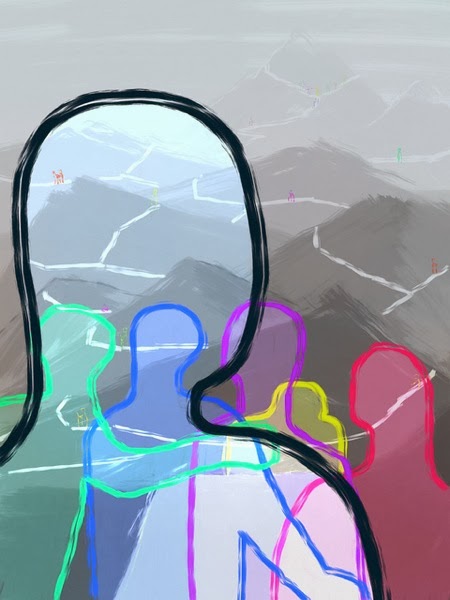
Armed with my rough, philosophical lens, the above looks to me very much like a correspondence theory: correspondence here is the relationship Francis speaks about, the truth-maker is God and his creation and the truth-bearer are my own, circumstance-, culture-, language-relative beliefs, thoughts and utterances. The truth-maker is absolute and objective, while the truth-bearer is ultimately its opposite: relative, in flux and existentially subjective. The image of a journey and of being embraced express the entities of this scheme in an intuitive way. On the one hand, the givenness and quiddity of the landscape, which envelops the traveller, and on the other hand, the subjective, observer-dependent experiences of it, had by the pilgrim (the "For now we see through a glass, darkly." of St. Paul (1 Corinthians 13:12)). What makes this paradigm profoundly Christian though is what Francis points to when he identifies truth with “the love of God for us in Jesus Christ.” The truth-maker is reaching out to the truth-bearer across the absolute-relative chasm, placing himself in relationship with His creatures, who are to Him like a dimensionless point is to the unbounded hyper-dimensional space.

Before you change channels, just bear with me while I try to put the above in other, less faith-dependent words. The concept of truth presented by Francis, as I understand it, is one that maintains the realism2 of a classical correspondence theory of truth, while acknowledging elements of contemporary truth theories that point to the impact of social, historical, conventional, linguistic and individually-subjective factors on the truth-bearers. Unlike truth theories that are marked by an absence of realism (e.g., coherence, pragmatist, verificationist and constructivist ones), here the imperfect and inherently subjective truth-bearers are still in relationship with their truth-makers. Up to this point, the theory does not make recourse to Christian beliefs and could just as easily be held by an atheist, in my opinion. Where it diverges is then in the belief that the truth-maker is not only an objective reality but also a personal agent who actively seeks to relate to the subject owning the truth-bearers. I didn’t say I’d put it more simply :)


1 Apologies to my überbestie MR - a fully-qualified and practicing professional philosopher - for bringing the name of philosophy into disrepute. I am sure she could have done a far superior job of the following.
2 And by “realism” I mean that the truth-makers are posited to exist independently of the truth-bearer’s circumstances - not the typical, ordinary-language meanings of the term.