Thursday, 24 August 2017

Abortion revisited

Consolatta

2310 words, 12 min read

Of all moral questions, abortion has for a long time been of very little interest to me, primarily because it just looked like such an open and shut case. A fetus is a human being and killing it is intrinsically evil,1 just like the killing of any other human. Since the fetus is furthermore defenseless and voiceless, its murder is even more reprehensible and unjustifiable. This, complemented by a strong sense of the need for mercy and compassion for all involved, regardless of their views or actions, is pretty much where I stood in 2013, when I last wrote about this subject, reflecting also on Pope Francis’ words about it at the time.

As far as the fetus is concerned, nothing has changed and I stand by what I wrote some four years ago. But, what about the mother? Where does the fetus’ right to life and the absolute evil of his or her murder heave her? What if she herself is a victim and feels coerced to abort? And why is it that abortion is promoted by clearly rational, well-meaning people and presented as intrinsic to curbing the injustice of gender-based discrimination? Yes, there may also be ulterior motives behind a promotion of abortion, but I find it increasingly hard to believe that that is all there is to it. As a result, I have set out to look into what motivates the promoters of abortion, with a desire to discover what good I may find.2

Let me start with philosophy, where my enquiry into abortion has lead me to the work of Judith Jarvis Thomson, who wrote “A Defense of Abortion” in 1971. Unlike the customary discussions about the human personhood or otherwise of the fetus, where abortion opponents affirm it and proponents deny it, Thomson asks the question of whether the inadmissibility of abortion can be taken for granted even if the fetus is taken to be a human person. With that starting point, she proposes the following thought experiment to test whether the fetus’ human personhood, and the right to life derived from it, necessarily lead to a prohibition of abortion:
“[I]magine this: You wake up in the morning and find yourself back to back in bed with an unconscious violinist. A famous unconscious violinist. He has been found to have a fatal kidney ailment, and the Society of Music Lovers has canvassed all the available medical records and found that you alone have the right blood type to help. They have therefore kidnapped you, and last night the violinist’s circulatory system was plugged into yours, so that your kidneys can be used to extract poisons from his blood as well as your own. The director of the hospital now tells you, “Look, we’re sorry the Society of Music Lovers did this to you--we would never have permitted it if we had known. But still, they did it, and the violinist is now plugged into you. To unplug you would be to kill him. But never mind, it’s only for nine months. By then he will have recovered from his ailment, and can safely be unplugged from you.” Is it morally incumbent on you to accede to this situation? No doubt it would be very nice of you if you did, a great kindness. But do you have to accede to it? What if it were not nine months, but nine years? Or longer still? What if the director of the hospital says. “Tough luck. I agree. but now you’ve got to stay in bed, with the violinist plugged into you, for the rest of your life. Because remember this. All persons have a right to life, and violinists are persons. Granted you have a right to decide what happens in and to your body, but a person’s right to life outweighs your right to decide what happens in and to your body. So you cannot ever be unplugged from him.” I imagine you would regard this as outrageous, which suggests that something really is wrong with that plausible-sounding argument I mentioned a moment ago.”
In the process of developing this initial thought experiment, which I think is ingenious and a great tool for digging deeper into what is involved when considering the rights and relationship of a mother and her unborn child, Thomson argues that unplugging the violinist would not be unjust since “you gave him no right to use your kidneys, and no one else can have given him any such right.” She then goes on to suggesting that a key difference between the thought experiment and the mother-fetus relationship is that the “fetus is dependent on the mother, [...] that she has a special kind of responsibility for it, a responsibility that gives it rights against her which are not possessed by any independent person--such as an ailing violinist who is a stranger to her.” Thomson argues though that this special relationship “would give the unborn person a right to its mother’s body only if her pregnancy resulted from a voluntary act, undertaken in full knowledge of the chance a pregnancy might result from it. It would leave out entirely the unborn person whose existence is due to rape.”

What Thomson’s clever thought experiment and in-depth analysis of its variants and consequences have done for me is first of all make me realize that there are relevant questions to consider here and that dialogue with those who support at least some forms of abortion (since Thomson herself is not in favor of blanket, indiscriminate use) could be possible. Secondly, it has shown me more clearly that my own convictions derive from considering the right to life and its value to be unconditional, since, if it were not, then, rationally, Thomson’s conclusions do follow.

Let me now turn to abortion as a phenomenon today, where even just a cursory glance quickly leads to some horrifying statistics. According to a paper provided by the World Health Organization, the annual worldwide rate of abortion in 1995 was 46 million, of which 26 million were legal and 20 million were not. Looking into the reasons behind abortion, a 1998 study, analyzing data from 27 countries (developing countries from Sub-Saharan and Northern Africa, Latin America, Asia + Czech Republic, Japan and US), presents the following sequence. In around half of the over 64 000 cases in question, the main reason for a mother to abort was “to postpone their next birth or to stop childbearing.” Second were economic reasons and poverty, which were cited as the main reason in around one fifth of cases, and as one of the deciding factors between a third and two thirds of the time, depending on geography. In third place were relationship problems, including “the partner’s objection to carrying the pregnancy to term,” which were a factor in between 10 and 40% of the cases. Being too young and unmarried had a similar frequency, although in some countries (e.g., Honduras and Mexico) it accounted for around a third of abortions. Finally, the risk to maternal health was also given as the main reason for abortion by 5-10% in seven countries and by 20-38% in three others (Kenya, Bangladesh, India) with the possibility of fetal defects playing a negligible role overall. Then there are even harsher cases, like those of rape and incest, whose occurrence in the US alone is a staggering 1% of the former and under 0.5% of the latter, i.e., 8000 and below 4000 at a US annual rate of abortion of around 800 000.

Turning to illegal abortions, it can be seen that 97% of them take place in developing countries (~10M in Asia and around ~4M each in Africa and Latin America), where these illegal abortions are unsafe, since they are performed “by individuals without the necessary skills or in an environment that does not conform to minimum medical standards, or both.” As a result, 68 000 women die annually due to the unsafe abortions performed on their fetuses by others or themselves - a mortality rate hundreds of times higher than for safe abortions (i.e., 367 versus less than one deaths per 100 000). This makes abortion be the cause of 13% of all maternal deaths, in 4th place after haemorrhage (25%), indirect causes (20%) and infection (15%). In some regions, such as parts of Latin America and Eastern Europe, abortion related deaths are the cause of as much as 30% of maternal deaths. Beside the scale of maternal mortality from unsafe abortions, their means too are bone-chilling and range from the ingestion of turpentine or laundry bleach, via the insertion of foreign bodies, such as knitting needles, sticks, coat hangers, ballpoint pens etc., into the uterus through the cervix, to the self-infliction of physical trauma, e.g., by jumping from the top of stairs or a roof.

Why is it that a woman would subject herself to such horrors to kill her own child? Again, remaining with the intrinsic evil of the fetus’ murder is not enough and a deeper understanding of the mother is needed.

It is not hard to see from the above that there is a clear element of violence, abuse, poverty, exclusion and discrimination here and that the disregard for the life of the fetus extends to that of its mother. The victims of abortion, on the part of the mothers include girls and women who are driven to abort by their environment and to do so in ways that are gruesome and potentially lethal to themselves. And there is no shortage of girls and women with names and surnames here who have suffered greatly before, during and after abortion. A high profile case here is that of the nearly 300 Nigerian high school girls - as young as nine years old! - kidnapped by Boko Haram in a single day, who were subsequently raped and impregnated “to create a new generation of fighters.”

Most of the time though, the trauma of sexual abuse and rape does not make the news, and the victims remain nameless. Had it not been for investigative journalism, that would have also been the case for Consolatta Wafula,3 who was raped by a local farmer and politician, a friend of her father and uncle, when she was a teenager. Her rapist arranged for an illegal abortion to be performed, which left Consolatta fighting for her life when she developed sepsis in response to an infection cause by the botched procedure. Subsequently she was arrested for having had an illegal abortion. To pay for bail and continuing medical bills, her family had to sell several of the cows that were their livelihood, as a result of which three out of six of of the family’s children had to stop attending school. Yes, I still believe that the murder of Consolatta’s fetus is inexcusable, but it is part of a much greater tragedy of exploitation, violence and evil, where it is Consolatta and her family who need to be mourned too included among the victims alongside her aborted child.

Looking at all of the above, I can understand why the United Nations speak about abortion in the context of human rights and women’s rights. Its Committee on the Elimination of Discrimination Against Women holds that “laws that criminalize medical procedures only needed by women and that punish women who undergo those procedures” are a barrier to women’s access to health care and discriminate against women. The Committee has also asked for “decriminalizing abortion when the pregnancy results from rape or sexual abuse,” which was further extended by the Maputo protocol’s Article 14 to cover “incest, and where the continued pregnancy endangers the mental and physical health of the mother or the life of the mother or the foetus.”

I still can’t think how aborting a fetus could be justified, but I see how it is morally a far less open and shut case than I thought before, when abortion takes place in a landscape of discrimination, violence, abuse, poverty and a disregard for all human life.


1 St. John Paul II sets out what is meant by “intrinsically evil” in the context of Catholic moral theology in Veritatis Splendor (§80), saying that such acts “are such always and per se, in other words, on account of their very object, and quite apart from the ulterior intentions of the one acting and the circumstances. Consequently, without in the least denying the influence on morality exercised by circumstances and especially by intentions, the Church teaches that “there exist acts which per se and in themselves, independently of circumstances, are always seriously wrong by reason of their object”. The Second Vatican Council itself, in discussing the respect due to the human person, gives a number of examples of such acts: “Whatever is hostile to life itself, such as any kind of homicide, genocide, abortion, euthanasia and voluntary suicide; whatever violates the integrity of the human person, such as mutilation, physical and mental torture and attempts to coerce the spirit; whatever is offensive to human dignity, such as subhuman living conditions, arbitrary imprisonment, deportation, slavery, prostitution and trafficking in women and children; degrading conditions of work which treat labourers as mere instruments of profit, and not as free responsible persons: all these and the like are a disgrace, and so long as they infect human civilization they contaminate those who inflict them more than those who suffer injustice, and they are a negation of the honour due to the Creator”.”
2A corollary of my method is that I will not seek out opinions that I consider to derive from contemptible motives, for the sake of the sport of attacking them, and that I will also apply the principle of charity to the material I do reflect on here.
3 Shown at the top of this post.

Thursday, 18 May 2017

Echoes of Jesus’ forsakenness in secular thought

Tracey emin man with child

1127 words, 6 min read

A central aspect of Christianity is Jesus’ suffering on the cross, to the point of calling out “My God, my God, why have you forsaken me?” (Matthew 27:46) shortly before his death. This moment of utter abandonment shows God making himself one with each one of us even in our darkest, loneliest, most desperate moments - a realization that gives us a glimpse of the extent of his love. It also invites us to look for him and encounter him in the suffering of others and ourselves, in the hope of joining him in the resurrection that follows.

Since this belief is in God’s presence in suffering being universal, it raises the doubt of whether those who do not share that belief nonetheless experience what Christian’s would recognize as a relationship with the forsaken Jesus. In fact, my own experience has been very much one of a resoundingly positive answer to this question. As I read the writings of agnostic or atheist thinkers, or those who follow other religions or philosophies, I keep coming across passages in which echoes of Jesus’ cry of abandonment can be heard. By this I certainly don’t mean to ascribe beliefs to their authors that they do not hold, but simply to say that their accounts are like those I would give of my relationship with the forsaken Christ.

Instead of an annotated reading, I would just like to offer a selection of my favourite such “echoes” next.

Jorge Luis Borges, Paradise, XXXI: 108:
“We have lost those features,  just as a magic number made up of ordinary figures can be lost;  just as an image in a kaleidoscope is lost for ever. We may come across the features and not know them. The profile of a Jew on an underground train may be that of Christ; the hands that give us our  change over a counter may echo those that some soldiers once nailed to the cross. Perhaps some feature  of the crucified face lurks in every mirror; perhaps the face  died and was erased so that God could be everyone.” 
Ted Hughes, letter to his 24 year old son:
“It’s something people don’t discuss, because [they] are aware of [it] only as a general crisis of sense of inadequacy, […] or a sense of not having a strong enough ego to meet and master inner storms that come from an unexpected angle. But not many people realise that it is, in fact, the suffering of the child inside them.

Everybody tries to protect this vulnerable […] eight year old inside, and to acquire skills and aptitudes for dealing with the situations that threaten to overwhelm it. So everybody develops a whole armour of secondary self, the artificially constructed being that deals with the outer world, and the crush of circumstances.

And when we meet people, this is what we usually meet [and we] end up making ‘no contact.’ But when you develop a strong divining sense for the child behind that armour, and you make your dealings and negotiations only with that child, you find that everybody becomes, in a way, like your own child. It’s an intangible thing. But they too sense when that is what you are appealing to, and they respond with an impulse of real life, you get a little flash of the essential person, which is the child.”
Slavoj Žižek, God in Pain:
“The crucial problem is how to think the link between the two “alienations” — the one of modern man from God (who is reduced to an unknowable In-itself, absent from the world subjected to mechanical laws), the other of God from himself (in Christ, in the incarnation) — they are the same, although not symmetrically, but as subject and object. In order for (human) subjectivity to emerge out of the substantial personality of the human animal, cutting links with it and positing itself as the I = I dispossessed of all substantial content, as the self-relating negativity of an empty singularity, God himself, the universal Substance, has to “humiliate” himself, to fall into his own creation, “objectivize” himself, to appear as a singular miserable human individual, in all its abjection, i.e., abandoned by God. The distance of man from God is thus the distance of God from himself. […]

In Christianity, the gap that separates God from man is not effectively “sublated” in the figure of Christ as god-man, but only in the most tense moment of crucifixion when Christ himself despairs (“Father, why have you forsaken me?”): in this moment, the gap is transposed into God himself, as the gap that separates Christ from God the Father; the properly dialectical trick here is that the very feature which appeared to separate me from God turns out to unite me with God.”
Marina Abramović, Tate Talk (25:47 - 27:19):
“We are always afraid of pain, of dying, of suffering. They are the main concerns of human beings. Many artists deal with these themes in different ways. I was always interested in how the different ancient people work with ceremonies and with the ritualization of inflicting very large amounts of pain on their bodies, even to the stage of clinical death. And the reason for this is not any kind of masochistic reason. The reason is very simple: to confront yourself with the pain, to confront taking this kind of risk, in order to liberate yourself from fear, to jump to another state of consciousness by doing it. I could never do this with my own private life, but if I stage the situation where it is painful, in front of the audience, the stage situation is dangerous in front of the audience, I take the energy of the audience and I can use it to give me strength to go through that experience. So, I become like your mirror. If I can do this in my life, you can do it in yours.”
Thich Nhat Hanh, How to Love:
“In a deep relationship, there’s no longer a boundary between you and the other person. You are her and she is you. Your suffering is her suffering. Your understanding of your own suffering helps your loved one to suffer less. Suffering and happiness are no longer individual matters. What happens to your loved one happens to you. What happens to you happens to your loved one. […]

In true love, there’s no more separation or discrimination. His happiness is your happiness. Your suffering is his suffering. You can no longer say, “That’s your problem.””
Tracey Emin, Serpentine Gallery Poetry Marathon 2009:
“To sleep

To sleep
not sleeping
To wake
not wanting
Night time comes
with feelings mixed
I want to drown myself
in my pillow
Force myself
through another world
I want to wake up
feeling love”

Friday, 31 March 2017

You have made my Father’s house a museum

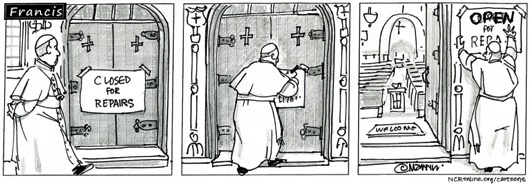
Francis open for repairs

1260 words, 6 min read

The Codex of Canon Law presents the salvation of souls as the supreme law of the Church (cf. Canon 1752), a principle that has its roots in the Roman law: “Salus populi suprema lex esto” (Cicero, De Legibus, Book III, Part III, Sub. VIII). As such, this law is designed to be invoked when choices are to be made about conflicting alternatives, as happens almost universally in the life not only of each individual, family, society but also of the Church. Does A contribute to the salvation of souls more or is it B? What is the objective of a project in terms of its impact on the salvation of souls? What role does some object, process, practice, building, etc. play from this perspective?

Before getting to the events that lead me to reflecting on this topic, it might be worth spelling out what constitutes the “salvation of souls” that ought to be the first priority. Here the Catechism of the Catholic Church speaks very plainly: “All who die in God’s grace and friendship [...] are indeed assured of their eternal salvation.” (§1030). Making the “salvation of souls” the “supreme law” therefore ought to be about inviting, encouraging, supporting God’s friendship. But, I hear you ask, what is it that merits God’s friendship? Like all good friendship, it is, in fact, unmerited and offered gratuitously. God does not have favourites or a predilection for certain “types” of people - put even better, and in the beautiful words of Patriarch Athenagoras: “God loves everyone equally, but secretly each one of us is his favourite.” However, like all friendship, friendship with God too requires work and a desire to please and bring joy to my friend. If I know that a friend likes the Big Lebowski, I quote from it to delight them (and myself), if they are into football, I show interest (even if my own is limited). So, the obvious question is: what is it that my friend, God, delights in and is passionate about? Again, like with all friends, it pays to listen closely, since they do drop hints here and there or even say outright what they like (marmalade, chocolate with hazelnuts, Camus and Hesse, walking, ...). God is no different. He tells us that he likes it when we offer drinks to the thirsty, food to the hungry, to welcome strangers, clothe the naked and visit prisoners (cf. Matthew 25:31-46). He also has a preference for mercifulness, peace-making, meekness, justice and accepting unpleasantness for his sake (cf. Matthew 5:1-12), for not judging (cf. Matthew 7:1), for not returning violence with violence (cf. Matthew 5:39) and he is keen to have children be close to him (cf. Matthew 19:14). My reading of the “supreme law” therefore is that it calls for the Church to prioritise inviting, facilitating, supporting everybody’s friendship with God.

Against this, at the time implicit, background, I set out to mass in Milan’s cathedral on Tuesday morning, since I am at a conference here during these days. As I walked out of the Duomo underground station, I entered a square jam-packed with people behind whom the magnificent structure of the Cathedral’s pentagonal shape protruded into a dazzling blue sky. An ideal setting for friendship, no doubt. Getting closer to the church, I saw the first warning signs that the lex suprema might not be in force: a board displaying a complex, multi-SKU product portfolio of entrance fees and multi-destination ticket packages that offer access to the Cathedral for between 12 and 16 Euros (as it turns out, on the website there is a 3 Euro alternative, but this was not apparent from the information on display). Since I was on my way to mass first, I looked for a way to join it without paying for a ticket, since paying for mass is about as acceptable as paying my own children for a hug.

Sure enough, in one corner of the Cathedral’s facade, there was a barrier with a sign saying “confessione” with an official standing next to it and only letting those who say the right things join that queue. Past the barrier, a soldier with a machine gun across his back stops me and searches me with a hand-held metal detector, from the front and from the back. He wants to see the phone in my pocket and then waves me past. Next, still before entering the church, I have to open my bag and have its compartments reviewed by two more armed soldiers. Now I am ready to enter the Father’s house. Before reaching the holy water font at the entrance, I am welcomed by a sign reminding me that there is to be strictly no photography in this part of the church, reserved to those who have not paid for a ticket. Just in case those pesky faithful were to dilute the value offered to paying customers, I presume.

So, I’m in, but where is the mass? The vast central nave of the cathedral is reserved for visitors (not worshipers) and, with the exception of three people, is empty. Jam-packed square outside, empty cathedral inside. Revenue stream inside, potential friends outside. Lex suprema?

Asking two more officials along the way, I finally arrive in the space behind the main altar, originally designed for the choir, where a small contemporary-looking altar, lectern and tabernacle are tacked onto the back of the beautifully and ornately decorated main altar, of which we only see the (surprisingly detailed) backs of the saints adorning it. I am the third person to arrive for mass in a congregation that at its peak hits around 35 souls. The mass is beautiful in its intimacy and by virtue of the, to me, novelty of the Ambrosian rite. Nonetheless, I feel like we are tolerated instead of being at home, like we are allowed to share a museum’s facilities, out of the way of the revenue-generating visitor flow. How does this let us, the Church, be the salt and leaven that Jesus calls us to be (cf. Matthew 5:13, 13:33)? How is this choice of access to and utilisation of the cathedral a consequence of a preference for the salvation of all? What would Jesus say if he turned up here today? Would he calmly proceed through the security checks, or would he reach for a length or rope? (cf. John 2:13-16)

As you can tell, I wasn’t best pleased. I have to say though that my main reason for writing this is not to have a go at Milan cathedral or to suggest that the above is an insurmountable obstacle. Certainly, my issue here is not exclusively with the Archdiocese of Milan - this approach to managing church buildings is, sadly, pretty wide-spread (with differing degrees of objectionability), and I am also aware of the financial challenges and responsibilities of maintaining such buildings. Most importantly though, I also believe that the above is not an inhibitor to being Church, but rather a - in my opinion unnecessary - obstacle. In spite of such a presentation of a museum-management face of the Church, I and my fellow Church members are still free to invite others to friendship with God by how we relate to those who throng outside our cathedrals. While unpleasant, this experience has also been a wake-up call for me to look at those I walk past in this great city as brothers and sisters rather than as an anonymous mass, and with that disposition to be open to discerning God’s will in every present moment.

Thursday, 23 March 2017

Míla and the most beautiful king

Mila vlk

1188 words, 6 min read

His Eminence Cardinal Miloslav Vlk, archbishop emeritus of Prague and former President of the Council of European Bishops’ Conferences, died five days ago on 18th March. He was a giant of 20th century Christianity by the very simplicity with which he lived out the Gospel under the intrusive eye of an oppressive Communist regime. While having the permit to exercise his priestly ministry withheld and being forced to earn a living as a cleaner of shop windows, he shone as a genuine follower of Jesus and a faithful successor to the apostles.

It was during this period, as a child in the late 1970s and early 1980s, that I first met Míla, as we all called him at the time. Míla would appear out of the blue at clandestine gatherings of the underground Church that my parents took me to and would mostly remain in the background. Already then, at the age of around 5-6, it was clear to me that he was different. I’d spot him on the periphery of a meeting held in a forest (where we could pretend that we were just on a hike if the secret police turned up), deep in conversation with one person or another, and I’d be struck by a sense of witnessing an inexplicable closeness. A closeness that I would also experience first-hand on the few occasions when he spoke to me and that to this day remain etched in my mind.

Instead of telling you more about his life, I would here like to offer translations of a couple of passages from Míla’s talks and sermons as archbishop of Prague, from which his love for all radiates with great clarity.

First, in 2000 Míla spoke about the universality of our call to love and the importance of inclusion:
“Let us seek the lowest common denominator of the global age, which is one person’s love for another, put in secular terms: mutual solidarity. This value can truly be called global, because every human heart is directed towards it, created for it. [...] First of all it is possible to testify to love by not excluding anyone from it. In all religions love is understood as universal, as love towards all, without distinction or discrimination. Furthermore, it is also in the nature of God’s love to take the initiative, because God always loves us first and takes his love to the extreme. We too, if we want to be witnesses, must not wait, but take the initiative in love. We were created as a gift for one another and we become fulfilled only by placing our capacity to love at the disposal of our neighbors.”
During the Advent of 2008, Míla addressed the Czech Parliament with a reflection on the need to be open towards others, which echoed St. Irenaeus’ famous “The glory of God is man fully alive”:
“The good news of Advent consists in God knowing us, our fates, our steps, in him being open to us. Jesus reminded us that we as creatures is similar to God and has in his genes an essential openness towards others. To live this openness in practice in his life - that is the message and challenge of Advent. If it is so, then the person can reach their identity, to reach their peak, full of success, to develop their powers only in dialogue, in communication with another person. [...] During Advent, the basic statement of the Gospel about God is that God is love and and that he himself brought love into our lives, so that we may build our lives on its basis.”
In 2009, Míla started one of his talks with a warning that sadly has a heightened degree of relevance in today’s delusion of “alternative facts”:
“It is necessary to realize one extremely fundamental thing, which is the experience of the last century: Most disaster was brought into the world by ideologies, which had lies and hatred as their basis. Whether it was communism throughout that long line of the decades or Nazism, their basis were lies, untruth and hatred. The only thing built on this basis is misfortune.”
Later that same year, Míla spoke about our fraternity being rooted in God’s paternity and lined the idea to the call to an “ecstatic” life:
“We live, are destined to live “ecstatically”, not closed into ourselves, in ourselves, but to live for others and in the other. “Ex-stare” means to step out of oneself, not to live closed in only oneself. There our destiny, our lives’ calling is fulfilled - a call to existential exchange, to dialogue. For their own life the person needs to love and also to be loved! Being destined for love is being destined for community. That is the identity of every person. A person feels fulfilment, satisfaction, realization, if they find and live their identity with another.”
In 2010, during a visit to Reykjavik, Míla spoke about who God is and how he desires our closeness:
“Our God is an infinite God who loves us immensely. He is omnipresent, but he came even closer to us, so that we could be close to him, so that we could touch him. He took on a human body, entered our world as a human, became man, was born of the Virgin Mary. At the end of his life, after his death, he rose from the dead with his transformed body (which is not subject to time and space), so that he could then be in every place in the world, so that we may experience that he is close to us. After his death he said with these words: “I (the resurrected) am with you always, until the end of the world.” [cf. Matthew 28:20] In the Old Testament there is one very important sentence: My delight is to dwell with the sons of men. (cf. Proverbs [8:31]). Our God yearns to be with us.”
Míla returned to these thoughts on God’s closeness with heightened intensity when he spoke with his friend, Fr. Hubertus Blaumeiser, some weeks before his death:
“God is Father, he is close. In the past God was often seen as being far away. He was worshiped, adored, but as one who is distant. Even the liturgy was celebrated with this sense of the infinite distance between us and God. Instead, Scripture tells us that God is near. “It is my delight to be with the children of men,” we read in the Book of Proverbs. And Matthew’s Gospel ends with this assurance: “I am with you always, until the end of the world” (28, 20). We must help others to discover the God who is near!”
This closeness to God apparent also from some of Míla’s last words, spoken with great effort, which were reported as follows:
“During the last days, he did not have much strength to speak anymore. However, only hours before his death, according to his caregivers, he uttered the words “The most beautiful king”. When the doctor asked him whom he meant, Cardinal Vlk replied: “Jesus on the cross”.”
Thank you, dear Míla, for your closeness.

Mila

Friday, 20 January 2017

Ethics in the Time of Human Fragility

Jurek 2

1310 words, 7 min read

The other day I came across an article entitled: “Ethicist says ghostwriter’s role in ‘Amoris’ is troubling”, in which an ethicist is troubled by Pope Francis having had the help of others when drafting his encyclicals and where one of these others, Archbishop Víctor Manuel Fernández, has used passages from his previous writings. Not only is this “material plagiarism” but it also undermines whether the encyclical is “magisterial” in the opinion of the aforementioned ethicist. While this line of inquiry does not hold much appeal (or water, in my opinion), it has lead to a response by Archbishop Fernández, who takes issue with how his views are presented in the article and who points to one of his papers for clarification.

Having read - and enjoyed - that paper, entitled “Trinitarian life, ethical norms and human fragility,” I would like to offer a partial translation and summary of its content next.

The paper starts with an enumeration of various flavors of relativism, from the theological, via the humanist, the mystical, the cultural, to the fragmentary, all of which are dismissed with reference to St. John Paul II’s Veritatis Splendor, which defends objectivity and which affirms the existence of “intrinsically evil” acts.

Fernández then goes on to recognizing that even these erroneous approaches to morality may contain “fragments of truth” and “legitimate aspirations”, but he points to a need for persisting with an integral Gospel world-view where, as the Compendium of the Social Doctrine of the Church affirms that ethical questions: “must be considered as a whole, since they are characterized by an ever greater interconnectedness, influencing one another mutually” (CSDC, 9).

At the same time, the Church has, for some time now, recognized that there exist circumstances that may reduce, “or under exceptional circumstances even annul” the moral responsibility of subjects and Fernández quotes from St. John Paul II’s 1995 Evangelium Vitae to back up his claim:
“Decisions that go against life sometimes arise from difficult or even tragic situations of profound suffering, loneliness, a total lack of economic prospects, depression and anxiety about the future. Such circumstances can mitigate even to a notable degree subjective responsibility and the consequent culpability of those who make these choices which in themselves are evil.” (§18b)
Fernández then points to three examples of the Church’s response to moral questions, where responsibility and culpability have recently been addressed: euthanasia, divorce and remarriage and same-sex sexual relations.

First, the 1980 declaration on euthanasia by the Congregation for the Doctrine of the Faith, entitled Iura et Bona, recognizes that under some circumstances people may no longer be truly responsible for what they do:
“by reason of prolonged and barely tolerable pain, for deeply personal or other reasons, people may be led to believe that they can legitimately ask for death or obtain it for others. Although in these cases the guilt of the individual may be reduced or completely absent, nevertheless the error of judgment into which the conscience falls, perhaps in good faith, does not change the nature of this act of killing, which will always be in itself something to be rejected.” (Part II.)
Second, a declaration by the Pontifical Council for Legislative Texts from 24th June 2000 stated that, even though the situation of the divorced and remarried is a matter of “grave sin, understood objectively, [a] minister of Communion would not be able to judge [its] subjective imputability” (2a.).

Third, as regards same-sex sexual relations, the Congregation of the Doctrine of the Faith stated in 2001 that “there is a precise and well-founded evaluation of the objective morality of sexual relations between persons of the same sex. The degree of subjective moral culpability in individual cases is not the issue here.” (§2b) Again, drawing a clear distinction between the objectivity of an act’s moral goodness and the responsibility that a person bears for it.

Against this background, Fernández then proceeds to introduce grace into the picture, by arguing that:
“If an action of a subject who is strongly conditioned can be objectively evil but not imputable - and therefore not culpable - then, consequently, it does not deprive this person of the life of sanctifying grace. When this action does not stem from responsible freedom, but is enormously conditioned instead, it cannot be imputed to the subject as a sin that deprives them of supernatural life with its trinitarian dynamics.”
Next, Fernández is careful to point out that the result here is not a change to the objective evil of such actions - they do not become virtuous or of merit to the subjects who perform them. Instead, it is in the good intentions of the subject in which “the love of God and trinitarian life can shine forth” and not in what remain objectively evil actions. “No matter how much a person acts in good faith, and no matter how good their intentions may be, this does not alter the moral qualification of an objectively evil act and neither does it convert it into an expression of love.” What Fernández therefore means by “in” when he says that “trinitarian dynamics can also come about in an objective situation of sin” is an “in the context of” or an “in the midst of” and not a “through.”

In fact, Fernández later proceeds to underlining the effects of the presence of grace in good intentions that may lead to objectively evil actions, which is that:
“Grace itself provokes an interior desire to please God more with one’s own life or to follow more perfectly one’s own internal impulses. In grace itself - even when its dynamics may be conditioned by inculpable deficiencies - there is a tendency to wake up the desire for overcoming such conditioning. Because of this, the person who has been conditioned continues to experience a certain “this cannot be” in their own way of living.”
Following a reflection on St. Thomas Aquinas’ distinguishing between external and internal acts when it comes to morality, Fernández argues that while love cannot coexist with mortal sin, it can “coexist with inculpable evil acts, where some of the conditions required for grave sin are not met.” Turning to the Gospel, Fernández then points to its call to the correction of persons based on the evil of their actions (cf. Matthew 18:15) but without judging their responsibility and culpability (cf. Matthew 7:1; Luke 6:37). In summary, Fernández underlines that fraternal correction, including sanctions that the Church may legitimately impose, do not imply the emission of judgment about the interior situation and the life of grace of the corrected brother: “de internis non iudicat pretor,” as the Roman juridical maxim goes (“the judge does not judge what is on the inside”).

The above context leads Fernández to spelling out his understanding of the key to Gospel morality:
“At the same time as focusing on a subject’s full compliance with moral laws, they always have to be encouraged also to grow in love with their own acts, which will never stop being the most important of the virtues and “the fulfillment of the law” (Romans 13:10). Without it there is no merit whatsoever and neither is there any authentically evangelical growth.”
Fernández concludes the article with putting his cards on the table and spelling out the motivation for his enquiry into the workings of grace. After rejecting the suggestion that it is a result of responding to secular prejudices or to theological progress, Fernández traces his thought to his time as a parish priest in a poor neighborhood in Argentina, because of which he desires to show two things at the same time:
“the immense mercy of God in the face of the limited and conditioned response of human beings, and the inescapable call to a generous surrender that may ever more perfectly respond to the objective proposal of the Gospel that the Church offers to the world.”

Tuesday, 3 January 2017

Scandal: stumbling blocks to steppingstones

823 words, 4 min read

The term scandal has its origins in the Hebrew Bible, where in Leviticus 19:14 it says: “You shall not insult the deaf, or put a stumbling block in front of the blind, but you shall fear your God.” This verse, where the Greek for stumbling block is skándalon (σκάνδαλον), is in the middle of an extended version of the ten commandments (including prohibitions of stealing, of bearing false witness, and even of excessively harvesting grapes or grains) and, at first sight it looks rather odd. Did the Chosen People widely practice the tripping up of the blind and did they do so by means of a dedicated gadget - the stumbling block?

Reading Rabbi Shlomo Itzhaki’s commentary from the 11th century, it can be seen that blindness here is to be read figuratively, and in any case, the Bible is already full of proscriptions about harming others, whether they are blind or not:

“Before a person who is “blind” regarding a matter, you shall not give advice that is improper for him. [For instance,] do not say to someone,“ Sell your field and buy a donkey [with the proceeds], ”while [in truth,] you plan to cheat him since you yourself will take it from him [by lending him money and taking the donkey as collateral. He will not be able to take the field because a previous creditor has a lien on it.]”

The skándalon that Leviticus warns against is therefore the scandal of taking advantage of the weak, rather than a new discipline in the Upperclass Twit of the Year competition. And it is this that Jesus himself has very strong words about: "Whoever causes one of these little ones who believe [in me] to sin, it would be better for him if a great millstone were put around his neck and he were thrown into the sea." (Mark 9:42), where the Greek for "causing one to sin" is skandalisé. St. John also speaks about scandal, but in a positive way in that it's absence is a sign of love: “Whoever loves his brother remains in the light, and there is nothing in him to cause a fall.” (1 John 2:10), where "to cause a fall" is again skandalon.

Scandal, as far as Scripture is concerned is an act whose effect is to take advantage of another, to exploit them, or (and this is particularly prominent in Jesus' words) to lead them to sin. Jesus goes out of his way to discourage us from conduct that leads another to sin, i. e., that inhibits another person's ability to love. If I do something that triggers in another person a a giving in to temptation, a turning in on themselves, a putting themselves before others, then it is I too who will be held accountable.

Pope Francis has also spoken often and harshly about scandal and has particularly chided the scandal of hypocrisy, of divisions between Christians and of exploiting the poor.

Fundamentally, being warned about the risk of scandalizing others is a call to love, which is a being directed towards the good of others in a self-noughting, self-othering movement. While the immediate scope of love concerns my actions being directed towards what the other lacks, needs, enjoys, desires, the warning against scandal extends the scope of these considerations beyond the direct recipient of love to all others, on whom my actions may have a negative effect. If I behave in a hypocritical way, or if I act in a way that harms others, the result may be a skándalon, a stumbling block that leads to an impaired capacity for love in others, who may be mere bystanders and observers of my life. Yet Jesus calls me to loving them too, and he makes it clear that failing to do so is no trifle.

So far, so good. I need to pay close attention to the impact of my actions on all who witness them. However, there is another side to scandal that, I believe, needs to be borne in mind, which is its inherent asymmetry. I believe that it is as important to avoid causing scandal as it is to avoid being scandalized. Just like my causing scandal inhibits another's capacity to love, so my being scandalized inhibits my ability to love others. If I let myself be scandalised, a wall rises up between me and the person whose actions scandalize me and I become unable to love them. I see them as a danger to my holiness, instead of the brother or sister who they are. Just like Jesus shunned no one, even those who caused others great scandal, like tax collectors and prostitutes (cf. Mark 2:15), so I too need to develop His eyesight so that I may recognize the skandaloi that are in my way and transform them into steppingstones towards their owners instead.

Monday, 12 December 2016

Enfleshment

Michelangelo drawing

1221 words, 6 min read

Are there some places or objects that are more sacred than others? Is there anything special about the spot where Jesus was entombed after Joseph of Arimathea obtained his dead body from Pontius Pilate? How about the relics of saints, do they deserve special reverence? Or the cell where St. Theresa of Ávila spent her life, the patch of soil where St. Francis is buried or the spots where Dietrich Bonhoeffer was hanged or St. Thomas More beheaded? Are they any different from your local supermarket?

Before a hasty “yes” to the above, let’s approach the question from the other end too. Isn’t all of creation, the entire Universe made holy because it has been created and is being sustained by God, because it has being only insofar as God makes it participate in His own? Isn’t God present everywhere and always? Isn’t it the case that wherever I may go, God is already there, awaiting me and waiting for me to discover him and relate to him there? Isn’t each person equally loved by God and therefore given equal dignity and worth? Shouldn’t we see His presence everywhere, always, in everything and everyone? Doesn’t that result in universal equality and equivalence?

As with very many questions of this kind, I believe the answer is a resounding “both” and the template in this case could be Patriarch Athenagoras’ saying: “God loves everyone equally, but secretly each one of us is his favorite.” It is both a confirmation of universal equality and of individual exceptionality and I believe that both are needed in equal measure. Focusing only on the former, universal aspect brings with it a danger of declaring a love of humanity while not particularly liking any one person, a danger of emphasizing the general principle while loosing sight of the instances in ought to be applied to. The risk here is an idealism that lacks flesh. A focus on the latter, instead risks an idolization of some while looking down upon others, a schizophrenia of reverence for people and objects that ostensibly possess special qualities while walking past the poor, the “ordinary”, the “everyday” whose dignity is equipollent. The risk here is a materialism - even when it may appear as sacred - that lacks soul.

What does a “both” attitude look like though, in the face of these seemingly polar opposites. Here, I believe the answer is the incarnation - and if you are not a Christian, please, bear with me, because I believe that the pattern of thought that it represents (and embodies!) is more broadly relevant.

Let’s see first how Pope Benedict XVI explains what “incarnation” means:
“Incarnation derives from the Latin incarnatio. St Ignatius of Antioch — at the end of the first century — and, especially, St Irenaeus used this term in reflecting on the Prologue to the Gospel according to St John, in particular in the sentence “the Word became flesh” (Jn 1:14). Here the word “flesh”, according to the Hebrew usage, indicates man in his whole self, the whole man, but in particular in the dimension of his transience and his temporality, his poverty and his contingency. This was in order to tell us that the salvation brought by God, who became man in Jesus of Nazareth, affects man in his material reality and in whatever situation he may be. God assumed the human condition to heal it from all that separates it from him, to enable us to call him, in his Only-Begotten Son, by the name of “Abba, Father”, and truly to be children of God. [...]

The Logos, who is with God, is the Logos who is God, the Creator of the world (cf. Jn 1:1) through whom all things were created (cf. 1:3) and who has accompanied men and women through history with his light (cf. 1:4-5; 1:9), became one among many and made his dwelling among us, becoming one of us (cf. 2:14).

The Second Vatican Ecumenical Council said: “The Son of God... worked with human hands, he thought with a human mind. He acted with a human will, and with a human heart he loved. Born of the Virgin Mary, he has truly been made one of us, like to us in all things except sin” (Constitution Gaudium et Spes, n. 22). Thus it is important to recover our wonder at the mystery, to let ourselves be enveloped by the grandeur of this event: God, the true God, Creator of all, walked our roads as a man, entering human time to communicate his own life to us (cf. 1 Jn 1:1- 4). And he did not do so with the splendour of a sovereign who dominates the world with his power, but with the humility of a child.”
At the heart of Christianity there is a co-existence, a simultaneity between the eternal and the transient, the splendid and the humble, the self-sufficient and the contingent, which invests the latter with the former. It elevates material reality to a status that is inseparable from the uncreated, the eternal, since the uncreated made Himself created, while retaining His uncreatedness.

Elevating the material through the incarnation also elevates the specific to the status of the general. Material being brings with it Leibniz’s principle of identity, whereby no two entities can be the same since they will always differ at least in temporal and or spatial location. Since no two material entities can be the same, their distinction and specificity is intrinsic to material being, whose elevation through God’s incarnation also raises the specific, delimited to the level of the general and infinite.

Because God became flesh, flesh becomes not only a signifier of His presence, a token, but His actual presence. The value that materialist atheism attributes to matter is therefore in no way undermined or diminished by the Christian’s belief in its being in relationship with God, its being a manifestation of His presence. Both can, and the Christian ought, lest they deny the reality of the incarnation, value the physical, without caveats.

Pope Francis, in fact, makes Christian love conditional on being connected to Jesus’ flesh, which the flesh of the poor, the suffering and the needy makes present today, and he has harsh words for those who de-flesh the Church:
“A love which does not acknowledge that Jesus came in the flesh is not the love with which God commands us: it is a worldly love, it is a philosophical love, it is an abstract love, it is a somewhat failed love, it is soft love. No! The criterion for Christian love is the Incarnation of the Word. [...]

[W]hoever wishes to love not as Christ loves his spouse, the Church, with his own flesh and giving life, loves ideologically: they do not love with the all their body and with all their soul. And this way of theorizing, of being ideological, as well as the proposals of religiosity which removes the flesh of Christ, which removes the flesh of the Church, going beyond and ruining the community, ruining the Church.”
Instead of distancing Christians from atheist materialists, the incarnation makes every Christian be as much of a materialist as their atheist brothers and sisters. It makes them be both materialists and theists, fully materialist so as to be fully theist.